Showing posts with label Asbury. Show all posts

Thursday, March 27, 2008

The Glories of Asbury

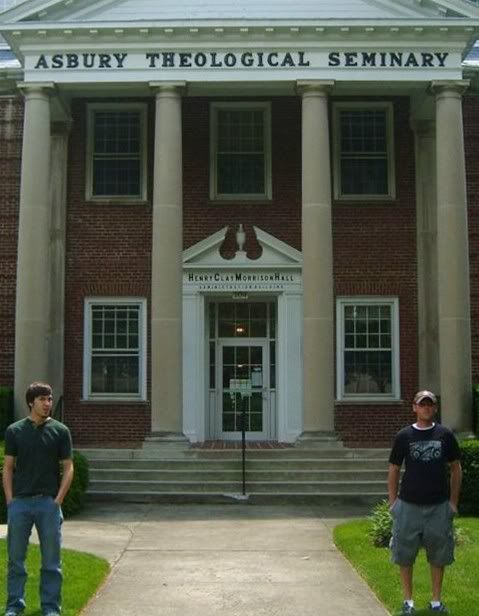
Well, I spent a wonderful first half of spring break in Wilmore, Kentucky with possibly the coolest group of people I have ever had the privilege of knowing. It was great being back on my old stomping grounds of Asbury Seminary's campus, seeing many familiar and many not-so-familiar faces. I got to meet with my old professor, Dr. Jerry Walls who was kind enough to give me a CD he produced of Charles Wesley hymns done in various genres in honor of Wesley's 300th birthday. I got to attend chapel in Estes on Tuesday and hear Asbury's president, Dr. J. Ellsworth Kalas, preach an Easter sermon. One of my favorite things at Asbury was hymn-singing in Estes Chapel as Albin Whitworth played the pipe organ. I was not disappointed on Tuesday as we sang "Christ the Lord is Risen Today," and "Up From the Grave He Arose."
I was in a Bible study with these guys during my two years at Asbury. 

Monday, March 24, 2008

A White Easter

He is Risen! For the first half of my spring break from Loma Linda I've returned to my home-away-from-home in Wilmore, Kentucky where I spent two years at Asbury Theological Seminary. I spent a blessed Easter with old friends at my old church, St. Patrick's Anglican. It was a wonderful service with a baptism the way a baptism should be. I especially enjoyed the preaching from Father Peter Matthews. It was a short message but it was one that confronted the reality of death with the stronger reality of the Resurrection. The day became even more interesting when last night it began snowing hard here in the Bluegrass of Kentucky. It only snowed for a while and there wasn't much more than a trace of accumulation but it was the first "white Easter" I had ever seen.

In his message Fr. Matthews talked about the unnaturalness of death. He talked about how the very center of our beings cry out against this reality we all must face. Fr. Matthews didn't preach that we should somehow embrace death as a natural part of life. He said that there is a reason why death seems so wrong to us. That is, we were not made for death but for life. In his message he quoted this poem from Dylan Thomas:

Do Not Go Gentle Into That Good Night
Do not go gentle into that good night,
Old age should burn and rave at close of day;
Rage, rage against the dying of the light.


Though wise men at their end know dark is right,
Because their words had forked no lightning they
Do not go gentle into that good night.


Good men, the last wave by, crying how bright
Their frail deeds might have danced in a green bay,
Rage, rage against the dying of the light.


Wild men who caught and sang the sun in flight,
And learn, too late, they grieved it on its way,
Do not go gentle into that good night.


Grave men, near death, who see with blinding sight
Blind eyes could blaze like meteors and be gay,
Rage, rage against the dying of the light.


And you, my father, there on the sad height,
Curse, bless me now with your fierce tears, I pray.
Do not go gentle into that good night.
Rage, rage against the dying of the light.

Tuesday, November 20, 2007

More Asburians in L.A. . . . Well, actually Pasadena

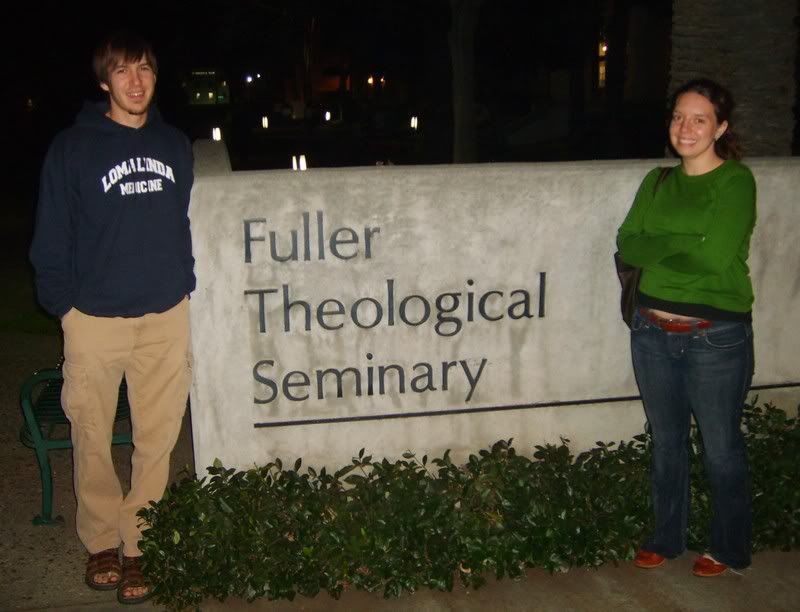
I got to start my Thanksgiving break by hanging out with a good friend from Asbury, Anna and one of her friends, Allison, who is also in medical school in Texas. Anna is thinking of doing Ph.D. work at Fuller and was visiting there with Joel Green who used to be at Asbury. It was a lot of fun to see Pasadena and just to hang out and catch up.

Sunday, November 18, 2007

Asburians in L.A.

Today I unfortunately did not get to worship with my brothers and sisters at Christ’s Church - Anglican, but I did get to go to Korea-town in L.A. and worshiped at the church of one of my classmates. It was a Korean Methodist Church that we went to and I had the great pleasure of meeting an Asbury Seminary graduate, Pastor Park. We chatted for a while and I found that he had gone to Asbury in the nineties and had lived in Larabee. He seemed also to have had a wonderful experience at Asbury as I had. I was impressed with his preaching and the ministry he has in L.A. to mostly Korean-Americans in their twenties. The ministry seems to emphasize the need for community among Christians and today he concluded a sermon series on friendship. He emphasized the need of cultivating friendships that will spur us on spiritually to draw closer to God and do his will. After worship, the church served everyone a very tasty Thanksgiving dinner.

Monday, July 9, 2007

And Now for Something Completely Different

I'll be mountain climbing for the next few days so I wanted to post something before I left. I was thinking about posting a cool quote from John Calvin on holiness, which I will probably post later, but I decided to post something I've wanted to put on here for a long time. I read a lot of good books my last semester at Asbury. But one quote from one book has stayed with me. It is from a book I read in Jerry Walls' class on theodicy called "The Doors of the Sea." It is by Eastern Orthodox theologian, David Bentley Hart...

Until that final glory, however, the world remains divided between two kingdom, where light and darkness, life and death grow up together and await the harvest. In such a world, our portion is charity, and our sustenance is faith, and so it will be until the end of days. As for comfort, when we seek it, I can imagine none greater than the happy knowledge that when I see the death of a child, I do not see the face of God but the face of his enemy. Such faith might never seem credible to someone like Ivan Karamazov, or still the disquiet of his conscience, or give him peace in place of rebellion, but neither is it a faith that his arguments can defeat: for it is a faith that set us free from optimism long ago and taught us hope instead. Now we are able to rejoice that we are saved not through the immanent mechanisms of history and nature, but by grace; that God will not unite all of history's many strands in one great synthesis, but will judge much of history false and damnable; that he will not simply reveal the sublime logic of fallen nature, but will strike off the fetters in which creation languishes; and that, rather than showing us how the tears of a small girl suffering in the dark were necessary for the building of the Kingdom, he will instead raise her up and wipe away all tears from her eyes - and there shall be no more death, nor sorrow, nor crying, nor any more pain, for the former things will have passed away, and he that sits upon the throne will say, "Behold, I make all things new."

Obviously I am not a Calvinist. Dr. Walls cured me of that. Don't get me wrong, I have great respect for John Calvin and I like many Calvinists. My favorite line is, "
God will not unite all of history's many strands in one great synthesis, but will judge much of history false and damnable." There are things in this world that happen and exist and are contrary to the will of God. It is only a hope in God's victory in the Eschaton that can make sense of the world we live in. I thank God for the tokens of His promise that we receive in this life.

Monday, July 2, 2007

The Making of a Charismatic or “Fan the Flame”

Some of you who know me well know a bit of my Christian journey. I was baptized as an infant at Ontario United Methodist Church in Ontario, Oregon and I asked Jesus to be my Savior when I was 13. I remained a very immature but zealous Christian until college. In college I wanted to party so I decided to become a liberal “Christian.” God by his grace brought me back to the faith with some relationships, some books and with my own inner struggle. For the next few years, while I was a youth pastor at a United Methodist church, I tried to embrace mainstream Evangelicalism. It was actually a very good time where God’s presence was very evident in my life and where I began to ask the Holy Spirit to take control of my prayer. I felt called to seminary and went to Asbury where I was richly blessed by God.

God messed with me a lot during my first year at Asbury. I came out of that year broken. I struggled regularly with fits of depression and anxiety. I told a friend that I felt “weak.” I also struggled with doubt a lot during that time. There were weeks when I had to will myself into being a Christian. But during that time God continued to meet me, I would say, miraculously. When I returned home to Washington from seminary in 2006 I was invited by a good friend and brother in Christ, Josh Monen, to a church service that was a ministry of a local Pentecostal church. The ministry was called ‘Fan the Flame,’ taken from 2nd Timothy 1:6 - “For this reason, I remind you to fan into flame the gift of God, which is in you through the laying on of my hands.” I was suffering the first time I went. The service was held in a barn in the countryside not far from my house. We worshipped and there was a short message. Then there was a prayer time. A family went up to be prayed for and I imagined that the service would wind down and I would talk with my friend for a while and go home. But that’s not what happened. As I said, I was suffering. I was standing about halfway back in the congregation, minding my own business, when the guy who had preached, Ross, pointed at me and said something like, “you need prayer.” He couldn’t have been more right. I went up and balled my eyes out before a whole congregation of people (something I had never done before and couldn’t imagine myself doing) while brothers and sisters layed on hands, prayed, prophesied and spoke in tongues. I asked for healing and I received it. I was free of the frightening depression and anxiety that had plagued me for months and it has not returned since. That was the first miracle of that summer. Fan the Flame continued to amaze me throughout the summer. I’ve commented to Josh that Fan the Flame has been the only place where, on a Monday, I was excited about what might happen at church on Sunday that week. There were a number of amazing things that happened that summer but one other thing is worthy of note. I’ve mentioned it on this blog before. One Sunday we had a guest preacher at Fan the Flame. I came to the service as usual not knowing what to expect but excited about what God had in store for that night. After he had preached, the guest preacher began telling random people from the congregation to stand up. He would then lay his hand on their head, pray, speak in tongues and prophecy. I am a skeptic. My natural reaction to every situation is to find a naturalistic explanation. I was skeptical about this preacher. I didn’t want him to prophesy over me because I loved Fan the Flame and I knew that if he said something that wasn’t true, I would be devastated. He walked down the center aisle, pointed at me and said, “stand up!” I obeyed and he began to speak in tongues and prophecy. He said something to the effect of “you have been hurt by a church in the past and you still need to forgive them.” First of all, I was happy that what he said was true. But I was also able to remain skeptical because I thought to myself, “lot’s of people have been hurt by churches - he could probably have said that to three quarters of the people here.” The fact was that I had been hurt by a church - the liberal church I had grown up in. But I thought I had forgiven the people there. After the service I went up to the preacher, Frank, and I let him know that what he said was true but that I felt like I had already forgiven those people. He looked at me and said something like, “I have something more to tell you - you are bitter about that church and that bitterness is affecting your theology.” I was surprised about having been contradicted but two words he used surprised me. The two words were “bitter” and “theology.” As I thought about it, I realized that this guy who didn’t even know me told me the same thing that the guy who knows me best, Blake Brodien, had been telling me for months at seminary. Blake had been telling me that I was bitter about liberalism and this ‘prophet’ now said the same thing. The other word that struck me was “theology.” This struck me because I was studying theology - and bitterness certainly was affecting it. In fact, I’d be willing to say that bitterness about liberalism was the primary force driving my theology. As you can imagine, that is a pretty unhealthy source of theology. As I thought about this true prophet’s words I grew more and more amazed. I was so amazed that I later asked my friend Josh whether he had talked to this preacher about me before the service - he hadn’t. On further thought, another aspect of the words of this prophet which struck me was that what he had to say was what I really needed to hear. At the service, before he prophesied over me, I had thought about what God would probably want to say to me through a prophet. I thought about the obvious struggles with sin in my life. I thought about lust among other things. But the struggle that this prophet hit me with was something that was very real but also something that I was in denial about. Hearing that I was bitter from him made me finally listen up after my best friend had been telling me the same thing for months. I would be lying if I said that the bitterness was gone - it’s not. But I’m aware of it and I realize that stoking it and feeding on it is keeping me in a kind of bondage that God wants me to be free of.

In my experience with Pentecostalism, I have seen little of what seems so problematic to those on the outside. That’s not to say that the problems aren’t real. But in my experience, Pentecostals are a group of people who value intimacy with God above all else, who believe the Bible and who are willing to live self-sacrificial lives. They are also aware of the marvelous and miraculous ways in which God acts in people’s lives today and they expect miracles in their churches. I believe that God honors this openness to His power by doing amazing things in Pentecostal churches.

Friday, June 29, 2007

For All Men From All Sin

As I said in my post yesterday, doing construction gives me a lot of time to think. Today I was thinking about what is central to the faith. I don't claim to have gotten some revelation, but I feel like God was messing with me. I was thinking about what I would be willing to break fellowship with a person over. I became convinced that a lack of commitment to holiness would be one of the first things I would break fellowship over. I would break fellowship over the issue of holiness before a lot of other theological issues that I also feel strongly about.

Holiness is central and many Christians have forgotten it or just don't want to deal with it.

I think that the only kind of Christian there can be is a radical Christian. Anything less and I think a person is risking, "Lord, Lord, did we not prohesy in your name, and in your name drive out demons and perform many miracles? Then I will tell them plainly, 'I never knew you. Away from me, you evildoers.'" Do we not believe that the road is narrow leading to salvation? Have we forgotten "unless your righteousness surpasses that of the Pharisees and the teachers of the law, you will certainly not enter the kingdom of heaven." Anyone who is not seeking utter obedience to God is condemned by Christ's words, "If anyone loves me, he will obey my teaching. My Father will love him, and we will come to him and make our home with him. He who does not love me will not obey my teaching." What was Christ's teaching on sin? To the woman caught in adultery he said, "leave your life of sin." He says the same thing to all of us. Do we love him enough to do it?

Is this holiness easy? Do we just get saved and have no desire to sin? Perhaps some have experienced entire sanctification at conversion but most do not. So what does this mean? It means that the Christian life is a constant battle against the flesh. It means that there are things in us, things that seem to be central to who we are that must be renounced and rejected in obedience to and trust in God. Jesus said, "If anyone would come after me, he must deny himself and take up his cross and follow me." Self-denial, cross bearing - not things that feel good but things we MUST do to follow Christ. There is no other way. These are the basic values that liberal "christians" utterly reject and that many other true Christians try to ignore.

We must also trust that it is out of God's love that he calls us to this holiness. If God becomes our portion, that is, if we truely experience the Presence of God in this life then I think that all the things we are called to leave behind will appear weak and ugly compared to what we gain in God.

Did Jesus' death and resurrection free us from needing to be holy or did they allow us to become holy? On a plaque outside of the chapel at Asbury College is written, "Salvation For All Men From All Sin." I believe it. Christ frees us from sin. That is what he calls us to. He didn't just die to give us a ticket to heaven. Heaven can begin now and there is no sin in heaven. 1st John 3:4-6 says, "Everyone who sins breaks the law; in fact, sin is lawlessness. But you know that he appeared so that he might take away our sins. And in him is no sin. No one who continues to sin has either seen him or known him."

Amen

Monday, June 11, 2007

Ryan Johnson: "Don't Judge Me?"

A friend from Asbury, Ryan Johnson, posted this on his myspace blog. I thought it was so good that I asked if I could post it here. Enjoy. . .

I always hear people saying, "Don't judge me," or "You have no right to judge me." They will even say things like, "Jesus tells us not to judge one another," or "Jesus didn't judge people, so why should you?" These are true statements, in part, but I think there is some confusion when it comes to judging others. I do not intend to go into depth on this, it's a blog for crying out loud, but I do want to scratch the surface.

It all started this morning when I was reading in 1 Corinthians (It's an AMAZING letter, by the way. You should read it :). In chapter 4, Paul says that no one should judge him, because "It is the Lord who judges me. Therefore do not pronounce judgment before the time, before the Lord comes, who will bring to light the things now hidden in darkness and will disclose the purposes of the heart. Then each one will receive commendation from God" (4:4,5). BUT, oddly enough, one chapter later he starts talking about how we are to judge those in our community.

Apparently there was a man sleeping with his stepmom, and Paul is rather upset that this man has not been removed from the worshipping community. He instructs them to "hand this man over to Satan for the destruction of the flesh, so that his spirit may be saved in the day of the Lord" (5:5). But what is the purpose of this? That the man will forever be ostracized from the community of faith? Absolutely NOT! But rather that he will turn from his ways and repent, and be allowed to reenter the church. He goes on to say, "For what have I to do with judging those outside? Is it not those who are inside that you are to judge? God will judge those outside. 'Drive out the wicked person from among you'" (5:12,13).

So which is it? Are we to judge? Or are we NOT to judge?
The Greek word being used here in these two passages is "krino", which can be translated "to judge, pass judgment on (midd. and pass. often stand trial, go to law); condemn; decide, determine; consider, regard, think; prefer." More than anything, though, the word is understood as "to come to a conclusion in the process of THINKING and thus to be in a position to make a decision - 'to come to a conclusion, to decide, to make up one's mind.' (i.e. 'for I made up my mind to know nothing while I was with you except Jesus Christ and him crucified' 1 Cor 2.2).

Jesus uses this word in Matt. 7, the definitive teaching on judging others, right?
"Do not judge, so that you may not be judged. 2 For with the judgment you make you will be judged, and the measure you give will be the measure you get. 3 Why do you see the speck in your neighbor's eye, but do not notice the log in your own eye? 4 Or how can you say to your neighbor, 'Let me take the speck out of your eye,' while the log is in your own eye? 5 You hypocrite, first take the log out of your own eye, and then you will see clearly to take the speck out of your neighbor's eye.

Does this teaching suggest that we are not to judge AT ALL? If Jesus had stopped at verse 4, then maybe so. But he doesn't. His teaching is to remove the log from your own eye, and THEN you can help your neighbor with his speck. The command not to judge does NOT mean that we should leave a person in their sin because we don't feel we have the right to condemn them. What it DOES mean is that we are to look at ourselves and recognize the total depravity of our own lives and the fact that it is only through Jesus Christ that we are saved. Only then can we look with compassion at the one in front of us.

The point I'm trying to make is that Jesus DOES tell us not to judge others, and that is true. BUT, there IS a place for "judging" others. Jesus' command not to judge does NOT mean that we are supposed to allow sin to persist in the world, but it DOES mean that we should not condemn a person for their sin. That type of judgment is left up to God.

There is ALSO a difference between judging a Christian and a non-Christian. This is what I am talking about:
1 Corinthians 5:9-11 9 I wrote to you in my letter not to associate with sexually immoral persons-- 10 not at all meaning the immoral of this world, or the greedy and robbers, or idolaters, since you would then need to go out of the world. 11 But now I am writing to you not to associate with anyone who bears the name of brother or sister who is sexually immoral or greedy, or is an idolater, reviler, drunkard, or robber. Do not even eat with such a one.

In this passage, Paul states that when Scripture speaks of not associating with immoral persons, it is not talking about those who are still in the world, i.e. the tax collector, the woman at the well, etc. We are not to judge, nor are we to distance ourselves from the world out there. BUT, if that immoral person is a brother or sister in Christ, then we DO have the right to judge, as a body, as a community of believers. IN FACT, Paul goes on to say, in chapter 6, that we should be judging between ourselves and not taking our matters to secular courts.

Judging others is a serious issue in our day. We judge people all the time for their words and actions without stopping to realize our own sins. However, when it comes to the body of Christ, Scripture DOES teach us to judge, but we must learn how to make wise decisions, and we must make those decisions with compassion.

I could go on forever with this line of thinking. There are so many more passages to look at, but I'll stop here. So what do YOU think?

Monday, May 21, 2007

The Blessings of Asbury Part IV: Conclusion

Asbury was a place where I met the Living God. I’m tempted to think that my faith in Christ, which I thought was very real before coming to Asbury, was not real at all. I feel like at Asbury God entered my heart. Before that, faith for me was more about assent to certain doctrinal truths (which is important) and not as much about a vital relationship with my Savior. My time at Asbury has made me much more aware of the presence of God and it has also taught me how radically God will change a person’s life if we allow Him to have control. I said to someone the other day that I feel like Asbury made me a man. I know that sounds funny. I was almost embarrassed to say it but I really believe that it’s true. There was a time when I sang the hymn “On Christ the Solid Rock I Stand,” and I wished that I could believe what I was singing. I believed that I had accepted Christ as my savior and I read the Bible and prayed daily but I didn’t trust Him enough for him to be a “solid rock” for me. Now that Christ has become this “solid rock” in my life, I find it easier to face many situations and I’m much less prone to depression and anxiety. My newfound trust in Christ has perhaps most importantly given me a new confidence. I have a confidence now that whatever might happen in my life, no matter how horrible it might be, the only thing that matters is that I am obedient to God. If I am seeking and serving Him then I have nothing to worry about. I believe that for the first time in my life and I revell in the awesome freedom that that confidence brings.

Saturday, May 19, 2007

The Blessings of Asbury Part III: Friendship

The most important blessing of Asbury Theological Seminary has been for me friendship. We have debated important issues, we have prayed for one another, we have confessed our sins to one another and we have encouraged one another toward holiness. The most transformative events that happened at Asbury for me, happened in Grice Hall. Those events were the Bible study group meetings, they were the conversations and debates that went into the morning hours, they were the times of heartfelt prayer and of crying out, "why God?" There are too many people who have blessed me greatly at Asbury to talk about but there are two who rise above the others. Those two are Blake Brodien and Ben Douglass.
I met Blake the first night I was at Asbury. We played poker and I remember not liking him much. Somehow we ended up becoming friends. We had Method & Praxis of Theology together and we realized how different we were from each other. Blake had grown up in an evangelical Christian home in the Bible belt. I grew up going to a liberal "church" where the gospel was not preached in the least-churched region of the country. Our diverse backgrounds has often made communication difficult. Our relationship made me realize that many people from "red state" regions underestimate the evils of liberal theology. It also has made me realize that right-wing fundamentalism can be just as bad. Blake could see during that first year of seminary that I was bitter. I was bitter about the liberalism that had withheld Christ from me and the havoc that it wreacked in my life. Blake told me that I needed to overcome that bitterness many times but I did not listen. It took hearing a word of prophecy, almost verbatim what Blake had been saying, from a pentecostal preacher the summer after that year of seminary for God to get my attention. I still have bitterness but now I'm aware of its presence and that it's something God wants me to be free of. Blake also got me through a battle with depression that first year. It was one of the toughest times in my life but Blake was always there to remind me of who God is and to pray for me. Our friendship has only deepened during our second year of seminary and I look forward to lifetime of being a blessing to one another. Blake showed me what true Christian compassion is. Being doctrinally correct and pursuing holiness are two of my most important values. Blake has taught me to add compassion to both my battle for good doctrine and my quest for holiness. Blake also has shown me a great trust in God that I can only hope someday to possess.

I didn't hit it off with Ben as fast as I had with Blake. The first time I really made a connection with Ben was when I was complaining about the problems of liberalism not far into my first year at Asbury. In Ben I found someone who was as aware as I was of the horrendous nature of theological liberalism. This realization led to many discussions about theology. Eventually we formed a "Barnabas Group" of which Blake was also a member along with two other guys. A Barnabas Group is an accountability group which combines Bible study, prayer and confession of sin along with a commitment to five disciplines. The disciplines are commitment to a certain amount of time in Scripture and prayer daily, fasting, tithing, church attendance and Scripture memorization. Our Barnabas group and more specifically my relationship with Ben has been the greatest catalyst in my life for greater holiness. I have been freed from sinful inclinations that I didn't even realize I struggled with and that I certainly never thought I would be free of. Ben has also made me more aware of the spiritual battle we are in. A big part of my growth at Asbury has come from being aware of this battle and knowing that the most important thing for a Christian to do in fighting the forces of darkness is to strive for holiness. This striving for holiness must always be built upon a faithful prayer life and time spent in the word. Ben has also showed to me how joyful and exciting a life can be where a person is seeking holiness. So often holiness is seen as boring or opposed to having fun. Through Ben I have come to see that in seeking holiness there will be many sacrifices and struggles but that He whom we are seeking to obey is so much greater than anything we might have to leave behind in our quest. Jesus says that we must deny ourselves to follow Him. Many Christians today seem not to want to hear this. Ben embraces Christian self-denial whole-heartedly and he has helped me to also.

Thursday, May 17, 2007

The Blessings of Asbury Part II: Classes and Professors

If you go to any school or educational institution you will hear people complain. We love to complain about the food in the cafeteria and the weird guy who lives upstairs in the dorm. We also love to complain about classes. I can join in complaining about some of the classes here. KCW and VOM were both wastes of time. But I've also had some amazingly good classes here:

COURSES

Church History 1 & 2 with Dr. Steven O'Malley. I love history and these classes did more to inform me on what it means to be Christian, perhaps more than any others that I took. Dr. O'Malley is very interested in Luther and Pietism among other things and his lectures on these topics were quite good. One of our biggest problems in the church is that we don't know where we came from and many of us think that it's not important. I think if more people took classes like these two, many of our disagreements would disappear if people had the humility to admit their mistakes. I think our willingness to compromise with our decadent culture on doctrine and practice would also decrease if we were all more mindful of the holiness and sacrifice seen in so many of the Saints of the Church.

The Gospel of Matthew with Dr. David Bauer. One thing Asbury has shown me is that people can be extremely intelligent and learned and still believe the Bible. Dr. Bauer is a prime example of this. This class has helped me to catch more of what is going on in Scripture.

Old Testament with Dr. Lawson Stone. I had no idea of how little I knew about the Old Testament before I took this class. The history I learned in this course was intriguing. Dr. Stone also provided a great amount of often not-so-appropriate humor to keep the class interesting. I also like Stone because he is very critical of postmodernism and isn't embarrassed about being a conservative.

Suffering, Tragedy and the Christian Faith with Dr. Jerry Walls. This is the best class I have ever taken. The readings were great and the class discussion was very instructive. The reading included an overview of modern attempts to deal with evil from the likes of Leibniz, Rousseau, Voltaire, Kant and Nietzsche among others. I came out of that portion of the course with a better understanding of the thought of those philosophers than an undergraduate philosophy course plus a lot of my own reading could give me. We reviewed some theodicies such as Plantinga's and then read a book that has changed my life: The Doors of the Sea by Orthodox writer David Bentley Hart. This book has revolutionized the way I look at the problem of evil. I would say that this course should be required but that would probably ruin it.

PROFESSORS

Dr. Steven O'Malley: Dr. O'Malley is perhaps the kindest and most humble Christian man I know. I could learn a lot from his patience and thoughtfulness in dealing with ideas. He always tries to see the best in people and he is very optimistic when it comes to what God is doing in the world. Optimism, and I'll admit it - humility, are not my strong points so I need to be around people like Dr. O'Malley to set me right. I took Church History 1 & 2, Sacraments in History and The Theology of John Calvin with Dr. O'Malley.

Dr. Jerry Walls: Dr. Walls is a clear-thinking intellectual with a hunger for truth. He doesn't compromise with the lack of logic that is prevalent in liberalism and postmodern thought. He actually believes in the law of non-contradiction which in this day and age is a breath of fresh air. Dr. Walls' classes engage my mind fully and inspire me to use my intellect to its full potential. If I could, I would take every class he offered.

In some ways Dr. O'Malley and Dr. Walls are opposites. My natural inclinations certainly lean toward the ways in which Walls thinks and confronts the world. If there were more men like Dr. Walls in the church I would be much more optimistic about it. But I also know that I have a lot to learn from men like Dr. O'Malley. Even though things may look dark, he joyfully trusts God and believes that He is working even in the midst of those with whom we disagree.

Wednesday, May 16, 2007

The Blessings of Asbury Part I: St. Patrick's Church

Now that finals are winding down and as I prepare to leave Asbury, I want to reflect on the amazing blessings I have received from God at this place. I have been at the seminary for almost two years now and my life has been transformed more profoundly in this time than any other equivalent period of my life. The first subject I will write on is the church I have attended almost the whole time I have been here. I found St. Patrick's church, thanks to my friend Ed, the third week I was at Asbury. The three great blessings of St. Patrick's I want to concentrate on are: St. Patrick's has allowed me to find God in the Eucharist and the liturgy; the preaching of our priest, Father Peter Matthews; and last but not least, the community at St. Patrick's - the people I've met in this church.

I Eucharist and Liturgy
Before I came to Asbury I had read some Catholic and Orthodox authors, particularly Chesterton, a Kempis and Dostoyevsky, which made me more open to those traditions. I had also become friends with a Catholic guy, who had great knowledge of the Fathers and an obvious devotion to Christ, at the book store I worked at in Vancouver, Wash. So when I came to Asbury I was ready to embrace liturgy and to have my understanding of the eucharist changed. St. Patrick's has been the perfect classroom to learn more about the liturgy. As my priest has said, "Liturgical prayer forces me to pray in line with the redemptive historical narrative of scripture. Liturgical prayer forces me to pray in line with God's will disclosed in scripture and the living tradition of the Church." I have also come to see that Scripture and the Church through the ages were serious when they said that the Presence of Christ is really in the eucharist. When you think of how God has chosen to relate to man, that is, incarnationally in His Son our Lord Jesus Christ, then it makes sense that God would continue to meet us materially. This happens in the eucharist. I believe that God meets me every week substantially there. I find that I have a hunger for it and and am fed spiritually each week when I take the true Body and Blood of Christ in the eucharist.

II The Preaching of Father Peter Matthews
I have been greatly blessed by the preaching of Father Matthews. His preaching is authentic and doesn't have the off-putting quality of some highly polished mega-church style sermons. Peter preaches from Scripture and he gives the word of God the highest authority in his sermons. He also often cites personal experience in his sermons which makes them easier to connect to our own lives. I wish that I would have taken notes more often at St. Patrick's but one sermon I do remember was on the line from the Lord's prayers, "Thy Kingdom come on earth as it is in Heaven." Peter defined the Kingdom as God's reign. He said that this was not a prayer of resignation like in Gethsemane and that Jesus isn't talking about us going to Heaven but about Heaven coming to us. I loved Peter's image of Heaven being right on the other side of a curtain, that it is real and immanent. This imagery made me think of an experience I once had when I was deep in prayer. I suddenly became profoundly aware of God's presence behind every object in the room, I felt that there was a kind of brightness behind the very blanket on my bed which I clutched as I prayed. It was one of the most mystical experiences I've ever had and I thank God for it. Another good point Peter made was that we don't build the Kingdom of God, God does. We are to be a witness to the Kingdom God has built and is building. We are to live lives that show what it looks like when God is in charge. Peter said in this sermon that discontentment comes from our placing our longing for hope and fulfillment in temporal things when our longing for hope should be placed on the Kingdom of God. He identified some basic longings that are fulfilled when the curtain is pulled back and the Kingdom is revealed, our longings for justice, beauty and for relationship and that these are all fulfilled in God.

III The Community
When I went on a church retreat earlier this year I became much more aware of how amazing the congregation at St. Patrick's is. We have a congregation of interesting people of diverse backgrounds who know how to have a good time and seek to serve the Lord and one another. It's been great going to church with some seminary people I've gotten to know better. Dr. Tsoukalas and his wife Sandy Richter go to St. Pat's and I've gotten to know him a little better. It has been interesting to hear him talk of the problems of postmodernism and how naively it has been embraced in many Christian circles. He encouraged me not to give up on Protestantism just yet and that people who will stand firm for doctrine should stay and fight - so that's what I'm doing. Another one of my favorite people at St. Pat's is Hubert who is a Greek professor at the University of Kentucky. It's great to see a committed Christian in the context of the secular university and I have been greatly impressed by his wisdom and great knowledge of a diversity of topics. I regret not having gotten to know many of my brothers and sisters at St. Patrick's church better.

Thursday, May 3, 2007

Wisdom from our elders III: Dr. David Bauer

On Tuesday our Barnabas Group (Bible study, prayer, accountability) had our last meeting with an "elder" from our seminary. We had the idea of inviting a more mature Christian once a month to share wisdom and insight about the Christian life. Earlier in the semester we had Dr. Joe Dongell and Emmanuel Akanet come and share with our group. This Tuesday we welcomed Dr. David Bauer, the dean of the School of Biblical Interpretation and Proclamation and Professor of Inductive Biblical Studies at Asbury Theological Seminary. Dr. Bauer is highly respected as one of the greatest intellects on campus and his knowledge of the minutest details of the Gospel of Matthew is quite amazing.

Dr. Bauer began with his story. He was born into a devout Free Methodist family. He said that he could not remember a time when he didn't have faith in God. In his parents he saw, "such authentic, genuine life that he was drawn to it."

Dr. Bauer went to Spring Arbor College and then came to Asbury Theological Seminary right out of college. His first year at Asbury was an unhappy one. Dr. Bauer struggled with whether or not he should be in Christian Education or be a pastor. He said that one experience he had while working at a church helped him to decide. He did not enjoy pastoral visitations but was on one and he found himself going through the conjugations of Greek verbs in his head during the visitation. This helped him to realize that education was probably a better route for him than pastoral ministry.

He got his Ph.D. at Union Theological Seminary and was immediately hired at Asbury. One challenge that Dr. Bauer mentioned about Asbury is that it can be a place where people want to look holy and this can discourage honest discussion about struggles and confession of sin. He stressed the importance of confession of sin saying, "one of the best ways to deal with sin is to acknowledge our failures." He said that Christian perfection begins with the recognition that one is not perfect.

An important aspect of his spiritual growth was his relationship with three men who served as mentors for him. He called them, "people in whom I saw Christ revealed most positively." All three of these men were professors in biblical studies. The most important of the three was Dr. Robert Traina who was a professor at Asbury. He said that these men taught him how to be a man. He said they taught him how to process things, how to relate to people and that they taught not only psychological and social maturity but also spiritual maturity.

When it came to the subject of his personal devotion, Dr. Bauer emphasized prayer and Bible study. He said that he gives specific times to prayer but also that he has a sense of constantly being in the presence of God and constantly being in conversation with God. He reminded us of Paul's words to, "pray without ceasing." He said concerning prayer and worship, "special times exist to indicate that there are no special times. They indicate that all time is sacred." Concerning Bible study, Dr. Bauer said that he doesn't like to separate devotional and academic reading of the Bible. He said that academic reading of the Bible should be worship.

When it comes to books outside of the Bible that have been highly influential for Dr. Bauer's life, he mentioned Bonhoeffer, Patristic literature, Luther, Calvin, Barth and Bruner.

It was wonderful to have Dr. Bauer with us. I felt a strong sense of holiness from Dr. Bauer and I believe that his words about abiding constantly in the presence of God are very true.

Thursday, April 26, 2007

End of Semester Insanity

The end of my last semester at Asbury Seminary in Wilmore, Kentucky draws near and my attention is focused on three large term papers I must finish by May 13th. I've taken some of the best classes I've ever had in any university setting this semester and all three papers should prove interesting. My classes this semester were "The Philosophy of C.S. Lewis" and "The Problem of Evil" with Dr. Walls and "The Theology of John Calvin" with Dr. O'Malley. Doctors Walls and O'Malley are two of my favorite professors here and the content of the courses has been quite good. I thought the subjects of my term papers might interest some of you so I describe them here below along with the appropriate illustrations:It's been cool taking a Calvin course at an Arminian seminary. I haven't yet taken our systematic theology (Basic Christian Doctrine) so the only systematic I will have taken on campus will have been John Calvin's. For class we've read the majority of The Institutes and a good biography by Wendell. My paper will focus on Calvin's idea of the third use of the law, how that theology affected his pastoral ministry and then compare that to Luther's concept of the law and how that affected his ministry. I'm not a fan of all of Calvin's theology but I do like his third use of the law. Basically, Calvin said that the law was useful to instruct Christians to lead a holy life. This is contrary to Luther's view where after a person is saved the law no longer has any claim on a person's life. “If I look to myself,” said Luther, “then all is flesh, all is sin. If I look to Christ, I am completely holy and pure, and I know nothing at all about the Law.”
I chose the cover of David Bentley Hart's book The Doors of the Sea as the illustration for my Problem of Evil class because I thought it was such a poetic and profound account of the problem of evil and theodicy. I highly recommend this book! This class has been the best I've taken at Asbury. The readings have been intensely interesting and the class discussions enlightening. I became interested in one theme from The Doors of the Sea - that of the problem of natural evil. Hart suggests that natural evil could be the result of demonic activity. I'm going to go at this problem, trying to defend the thesis that natural evil is actually the result of a corruption of creation resulting from the fall. I'm going to check out some commentaries on Romans 8:20-21, "For the creation was subjected to futility, not willingly, but because of Him who subjected it in hope; because the creation itself also will be delivered from the bondage of corruption into the glorious liberty of the children of God," and go from there. I've started on my Lewis term paper and hope to finish it tomorrow. I'm exploring some ideas surrounding one of the characters from Lewis' The Great Divorce. The character is the liberal Episcopal bishop. The bishop has taken a bus ride from hell into heaven and has a discussion with a former friend and classmate who is in heaven. The chapter is a wonderful indictment of liberal theology and I would say also much of postmodern thought. Let's just say I bring a lot of passion to this subject - I grew up in a liberal church and I'm still recovering. I think a lot of Christians, epecially those who have always been around evangelicals or fundies, are very ignorant of the serious dangers of liberal theology. I love what one of my professor's Lawson Stone had to say about liberalism, "I personally believe it to be the most effective heresy Satan ever fomented on the church."

Well, now I've spent another hour procrastinating. God's Peace.

Saturday, March 31, 2007

Ben's gettin' hitched

We threw a bachelor party for my friend Ben from the seminary at Lake Kincaid State Park friday night. We had a great time torturing Ben in various ways, applying fake tattoos, dousing him with shaving cream and then stealing his clothes when he went to take a shower. A high point of the evening was when Adam, Ed and Hess performed a "prophetic" dance for Ben to some Celtic music. We also had a great time introducing some of our international friends from the seminary to camping. Ong from Malaysia and Hye Jin and Chan Hun from Korea all went camping for the first time. It was an interesting night as some powerful thunderstorms went over and soaked the interiors of half the tents.


Friday, March 30, 2007

Republicans need not apply?


So I've become used to a lot of the self-righteous liberalism at Asbury Seminary. Fortunately, the group that most loudly beats the liberal drum here is a small one. But I was disappointed to hear that yesterday in chapel left-wing activist Jim Wallis got a standing ovation. Thankfully, I skipped it, having been up late writing a paper the night before but my friend Blake did go. I'll preface this by saying that Blake is not as conservative as I am. He is much more open to having "dialogue" with the lefties than I am. But Blake pointed out to me that Wallis said nothing worthy of a standing ovation. I think Blake's word for him was "skeezy." What makes me a bit angry, and shows some hypocricy among those who choose chapel speakers, is that a conservative would never be invited to speak here. At least if Wallis and his cronies trash what's left of Protestantism with his liberalism I can swim the Tiber or the Bosphorus. Thankfully, though, there is some reaction against Wallis-types going on. There are people here who think independently enough to realize that big-government, mindless pacifism and compromise with anti-Christian values is not the road ahead for Biblically-faithful Protestantism.

Wednesday, March 14, 2007

Wisdom from our elders II: Emmanuel Akanet

This Tuesday our Barnabas group met with our second "elder" to receive wisdom and spiritual guidance. Emmanuel Akanet is a Ph.D. student from Nigeria and is a member of the Evangelical Church of West Africa. He has a ministry to disabled people in Nigeria.

Emmanuel started our meeting by telling us to open to Matthew 28:16-20. Starting from this command of our Lord, Emmanuel began his story by telling of the missionaries who had come to Nigeria to bring the gospel to the Muslims in the north. He said that the Muslims were stubborn and not open to the gospel so these missionaries went to the non-Muslims who readily received the gospel. Emmanuel emphasized that his people had been evangelized by Muslims and had refused to convert but they had accepted Christ. His father was an evangelist to the Muslims in Nigeria.

Emmanuel next told us, "I am giving you my testimony so everytime you see me you will know that God is God." His mother died when he was two weeks old and his father died when he was four. Emmanuel presented his survival under these circumstances as miraculous. As Americans it may not seem miraculous but I think the conditions in Nigeria might make his survival quite miraculous.

As he grew up, Emmanuel felt a strong desire to serve the Lord. He was the head of his class in a large high school but with two years left he lost interest in all of his books other than the Bible. He went into the ministry after high school and two years later went to a Bible college. Emmanuel's second miraculous experience was God's providence in allowing him to come to the US. He told us of his prayer life and how people would unexpectedly come forward with money to support him.

Emmanuel warned that there will be many trials that a person who is going into ministry will have to go through. He said that some of the deepest wounds will come from other "Christians." He said, "We should be available like Philip and God will tell us to do what we have not planned to. God will tell us to do what does not make sense to us." He also said, "It took God miracles to keep me alive. It took God miracles to bring me here. It took God miracles to keep me here."

On the subject of spiritual warfare, Emmanuel gave us some sound advice. He said that some can cast out demons very easily and some can heal people easily by the power of God. He said that we should not desire to be like that minister - It is up to God whether we will cast out demons and heal people. In our personal lives, when it comes to spiritual warfare, he said that we simply need to focus on our relationship with God and give our life to God. The way in which we check our relationship with God is by asking: "Am I praying?" "Am I in the word?" "Am I portraying the love of Christ?"

It was a blessing to hear our brother from Nigeria speak. He was a prime example of the vital and committed Christianity we hear about in the global south.

Thursday, March 8, 2007

Wisdom from our elders I: Dr. Joe Dongell

On Tuesday our Barnabas group (Bible study & accountability) began a series of meetings with professors from the seminary to try to gain some insight and wisdom from older, more mature Christian men. Our first meeting was with Dr. Joe Dongell, Professor of Biblical Studies.

Dr. Dongell began by giving us his testimony. He grew up in the poorer industrial part of Philadelphia where his dad pastored a Wesleyan church. He became convicted one day after he heard his dad preach and decided to accept Christ as savior. He told his parents this and they prayed with him and then called friends from the church who had been praying that he would come to Christ. Dr. Dongell said that this was an important moment for him, when he realized that many in the church had been praying for his salvation. Dr. Dongell described his parents as people who knew God, who loved him, who loved others and who were humble. He was required to spend a certain amount of time each morning reading the Bible. He said that he never rebelled against his upbringing and this was because of the love for God and others he saw in his parents.

One question which came up had to do with evangelism. Dr. Dongell used the metaphor of wiring a house to describe his view. He said that rationalistic arguments and the reasonableness of the Christian faith serve as wiring for the house but that the wiring must be hooked to the "power grid" which is the Holy Spirit. This comes by bathing the relationship in prayer and inviting the Spirit of God to be present where evangelism is occuring.

On the question of the discipline of scripture reading, Dr. Dongell said that he likes to read and re-read books as wholes. He said the the margins in his Bible are filled with cross-references he has made. He said that he tries to go with a "last word, first word" principle in his life where the word of God is the last thing in his mind at night and the first thing in the moring.

On prayer Dr. Dongell said that his life has embraced two pathways, one of "instant prayer" and the other he called "mega prayer." The instant prayer is a high frequency of prayers throughout his day. His van doesn't have a radio so he prays while driving. He said he also sometimes prays a kind of "laughing prayer." The "mega prayer" is the prayer of confession, praise, petitions and spiritual petitions which he regularly makes for himself and others. He said that instead of trying to put this prayer into new words each time he prays it, he wrote out a fifteen page prayer with many scriptural references, he read it into and MP3 and put it on a CD. He will lay in his prayer nook, play the CD and agree with what he is praying. He said that he is surprised at times by what he hears on the CD. Dr. Dongell said that when he prays he always prays out-loud, never silently.

We were deeply blessed by Dr. Dongell's visit and we all sensed that Christ's presence is powerful and contagious in his life.