
H/T: Between Two Worlds
Showing posts with label Wisdom from our elders. Show all posts
Showing posts with label Wisdom from our elders. Show all posts
Monday, March 30, 2009

Thursday, May 3, 2007
Wisdom from our elders III: Dr. David Bauer
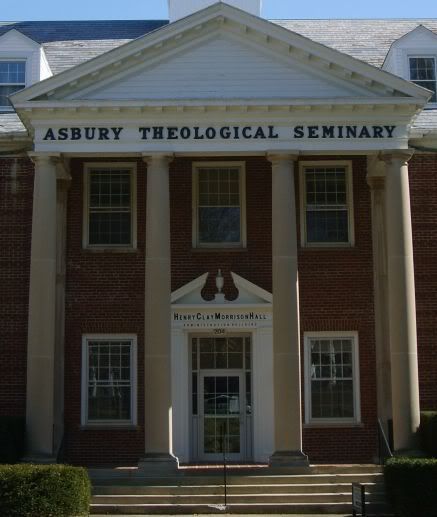 On Tuesday our Barnabas Group (Bible study, prayer, accountability) had our last meeting with an "elder" from our seminary. We had the idea of inviting a more mature Christian once a month to share wisdom and insight about the Christian life. Earlier in the semester we had Dr. Joe Dongell and Emmanuel Akanet come and share with our group. This Tuesday we welcomed Dr. David Bauer, the dean of the School of Biblical Interpretation and Proclamation and Professor of Inductive Biblical Studies at Asbury Theological Seminary. Dr. Bauer is highly respected as one of the greatest intellects on campus and his knowledge of the minutest details of the Gospel of Matthew is quite amazing.
Dr. Bauer began with his story. He was born into a devout Free Methodist family. He said that he could not remember a time when he didn't have faith in God. In his parents he saw, "such authentic, genuine life that he was drawn to it."
Dr. Bauer went to Spring Arbor College and then came to Asbury Theological Seminary right out of college. His first year at Asbury was an unhappy one. Dr. Bauer struggled with whether or not he should be in Christian Education or be a pastor. He said that one experience he had while working at a church helped him to decide. He did not enjoy pastoral visitations but was on one and he found himself going through the conjugations of Greek verbs in his head during the visitation. This helped him to realize that education was probably a better route for him than pastoral ministry.
He got his Ph.D. at Union Theological Seminary and was immediately hired at Asbury. One challenge that Dr. Bauer mentioned about Asbury is that it can be a place where people want to look holy and this can discourage honest discussion about struggles and confession of sin. He stressed the importance of confession of sin saying, "one of the best ways to deal with sin is to acknowledge our failures." He said that Christian perfection begins with the recognition that one is not perfect.
An important aspect of his spiritual growth was his relationship with three men who served as mentors for him. He called them, "people in whom I saw Christ revealed most positively." All three of these men were professors in biblical studies. The most important of the three was Dr. Robert Traina who was a professor at Asbury. He said that these men taught him how to be a man. He said they taught him how to process things, how to relate to people and that they taught not only psychological and social maturity but also spiritual maturity.
When it came to the subject of his personal devotion, Dr. Bauer emphasized prayer and Bible study. He said that he gives specific times to prayer but also that he has a sense of constantly being in the presence of God and constantly being in conversation with God. He reminded us of Paul's words to, "pray without ceasing." He said concerning prayer and worship, "special times exist to indicate that there are no special times. They indicate that all time is sacred." Concerning Bible study, Dr. Bauer said that he doesn't like to separate devotional and academic reading of the Bible. He said that academic reading of the Bible should be worship.
When it comes to books outside of the Bible that have been highly influential for Dr. Bauer's life, he mentioned Bonhoeffer, Patristic literature, Luther, Calvin, Barth and Bruner.
It was wonderful to have Dr. Bauer with us. I felt a strong sense of holiness from Dr. Bauer and I believe that his words about abiding constantly in the presence of God are very true.
Wednesday, March 14, 2007
Wisdom from our elders II: Emmanuel Akanet
 This Tuesday our Barnabas group met with our second "elder" to receive wisdom and spiritual guidance. Emmanuel Akanet is a Ph.D. student from Nigeria and is a member of the Evangelical Church of West Africa. He has a ministry to disabled people in Nigeria.
Emmanuel started our meeting by telling us to open to Matthew 28:16-20. Starting from this command of our Lord, Emmanuel began his story by telling of the missionaries who had come to Nigeria to bring the gospel to the Muslims in the north. He said that the Muslims were stubborn and not open to the gospel so these missionaries went to the non-Muslims who readily received the gospel. Emmanuel emphasized that his people had been evangelized by Muslims and had refused to convert but they had accepted Christ. His father was an evangelist to the Muslims in Nigeria.
Emmanuel next told us, "I am giving you my testimony so everytime you see me you will know that God is God." His mother died when he was two weeks old and his father died when he was four. Emmanuel presented his survival under these circumstances as miraculous. As Americans it may not seem miraculous but I think the conditions in Nigeria might make his survival quite miraculous.
As he grew up, Emmanuel felt a strong desire to serve the Lord. He was the head of his class in a large high school but with two years left he lost interest in all of his books other than the Bible. He went into the ministry after high school and two years later went to a Bible college. Emmanuel's second miraculous experience was God's providence in allowing him to come to the US. He told us of his prayer life and how people would unexpectedly come forward with money to support him.
Emmanuel warned that there will be many trials that a person who is going into ministry will have to go through. He said that some of the deepest wounds will come from other "Christians." He said, "We should be available like Philip and God will tell us to do what we have not planned to. God will tell us to do what does not make sense to us." He also said, "It took God miracles to keep me alive. It took God miracles to bring me here. It took God miracles to keep me here."
On the subject of spiritual warfare, Emmanuel gave us some sound advice. He said that some can cast out demons very easily and some can heal people easily by the power of God. He said that we should not desire to be like that minister - It is up to God whether we will cast out demons and heal people. In our personal lives, when it comes to spiritual warfare, he said that we simply need to focus on our relationship with God and give our life to God. The way in which we check our relationship with God is by asking: "Am I praying?" "Am I in the word?" "Am I portraying the love of Christ?"
It was a blessing to hear our brother from Nigeria speak. He was a prime example of the vital and committed Christianity we hear about in the global south.
Thursday, March 8, 2007
Wisdom from our elders I: Dr. Joe Dongell
 On Tuesday our Barnabas group (Bible study & accountability) began a series of meetings with professors from the seminary to try to gain some insight and wisdom from older, more mature Christian men. Our first meeting was with Dr. Joe Dongell, Professor of Biblical Studies.
Dr. Dongell began by giving us his testimony. He grew up in the poorer industrial part of Philadelphia where his dad pastored a Wesleyan church. He became convicted one day after he heard his dad preach and decided to accept Christ as savior. He told his parents this and they prayed with him and then called friends from the church who had been praying that he would come to Christ. Dr. Dongell said that this was an important moment for him, when he realized that many in the church had been praying for his salvation. Dr. Dongell described his parents as people who knew God, who loved him, who loved others and who were humble. He was required to spend a certain amount of time each morning reading the Bible. He said that he never rebelled against his upbringing and this was because of the love for God and others he saw in his parents.
One question which came up had to do with evangelism. Dr. Dongell used the metaphor of wiring a house to describe his view. He said that rationalistic arguments and the reasonableness of the Christian faith serve as wiring for the house but that the wiring must be hooked to the "power grid" which is the Holy Spirit. This comes by bathing the relationship in prayer and inviting the Spirit of God to be present where evangelism is occuring.
On the question of the discipline of scripture reading, Dr. Dongell said that he likes to read and re-read books as wholes. He said the the margins in his Bible are filled with cross-references he has made. He said that he tries to go with a "last word, first word" principle in his life where the word of God is the last thing in his mind at night and the first thing in the moring.
On prayer Dr. Dongell said that his life has embraced two pathways, one of "instant prayer" and the other he called "mega prayer." The instant prayer is a high frequency of prayers throughout his day. His van doesn't have a radio so he prays while driving. He said he also sometimes prays a kind of "laughing prayer." The "mega prayer" is the prayer of confession, praise, petitions and spiritual petitions which he regularly makes for himself and others. He said that instead of trying to put this prayer into new words each time he prays it, he wrote out a fifteen page prayer with many scriptural references, he read it into and MP3 and put it on a CD. He will lay in his prayer nook, play the CD and agree with what he is praying. He said that he is surprised at times by what he hears on the CD. Dr. Dongell said that when he prays he always prays out-loud, never silently.
We were deeply blessed by Dr. Dongell's visit and we all sensed that Christ's presence is powerful and contagious in his life.
Subscribe to:
Posts (Atom)

