 The old cross slew men; the new cross entertains them. The old cross condemned; the new cross amuses. The old cross destroyed confidence in the flesh; the new cross encourages it.
–A. W. Tozer
HT - T19
 The old cross slew men; the new cross entertains them. The old cross condemned; the new cross amuses. The old cross destroyed confidence in the flesh; the new cross encourages it.
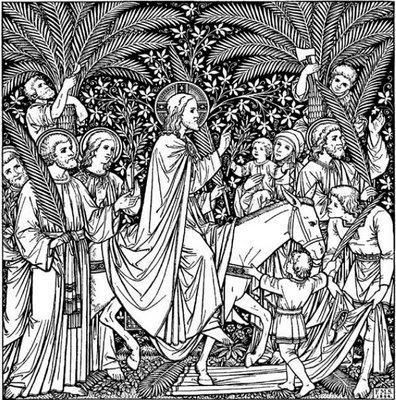 Happy Palm Sunday! As I got ready for church today and enjoyed the processional and liturgy I was reminded of Palm Sundays I celebrated as a child at our little Methodist church in Battle Ground, Washington. For some reason Palm Sunday was always one of my favorite days as a child. I remember Palm Sunday commonly being one of the first sunny or slightly warm days in the cold, rainy western-Washington spring. Perhaps God was showing his grace to all of the many church members who would be parading around their sanctuaries, waving palm branches that day. Another cherished memory of Palm Sunday involves the spear-like palm fronds that our church would always use. I remember regularly getting into trouble with my brothers as we turned our palm fronds into weapons to whip one another with as the good kids folded their palms into nice little crosses. I think another thing a I really liked about the day was its uniqueness. There is something unique about a bunch of reserved business-like people walking around a church waving palm branches.
Almost all of us at times find ourselves unable to sleep at night. We lie awake during the dark, silent hours. This rarely happens when our hearts and souls are at peace; it usually happens when we are troubled in some way. For this reason do not curse for your lack of sleep. These times of wakefulness have been sent by God as a sign that something is wrong, and as a period for reflection. So when you cannot sleep, allow the thoughts that lie deepest in your heart to rise up to the surface. Often these thoughts are a reproach, telling you of a sin you have committed or an act of charity you failed to perform. If you have already confessed and made amends for these past failures, then you must assure yourself that God has forgiven you, so that you can sleep in peace. But if you have not confessed and made amends, then you must confess at once, admitting to God the precise nature of your sin, and asking forgiveness. Then you must plan how the following day you can put right your wrong. You might be so troubled that even then you cannot sleep. But do not worry: your mind and body will eventually sleep when your soul is at rest.
- St. John Chrysostom
 I feel like this book adds something to the whole theodicy conversation. It is clear that God was at work even in the midst of the worst evil of the last century. God did not step in and limit the freedom of the Nazis as they committed their heinous crimes but God did use those who would be obedient even to the point of death to save some of His chosen people, the Jews, and to bring comfort and salvation to some of those in concentration camps who were about to go to the gas chambers. I was struck by the centrality of Scripture for the ten Boom family, how the Bible was the authority when it came to life and belief. I was also struck by a statement by Caspar, Corrie's father when, as a little girl, she asked him what "sexual sin" was. Caspar said something like, that is a knowledge that is too dark for you to be burdened with. Later that same line of thought is applied by Corrie to the problem of evil itself. I think that is one of the hardest things for us in this scientific age to accept that in this life we may not get pat and satisfying answers to our deepest, darkest questions. Even in the midst of this ambiguity we must find the ability to live a life of trust in God. If we can't learn to live with the things that don't make sense, I think we can only go down the road of despair or of dishonesty where we try to convince ourselves that the easy answers really satisfy us. When it comes to things like horrible diseases or the holocaust, no answer really satisfies me. But we must continue on, seeking to bring God's light, love and healing into the dark places and believing that these "present sufferings are not worth comparing with the glory that will be revealed in us."
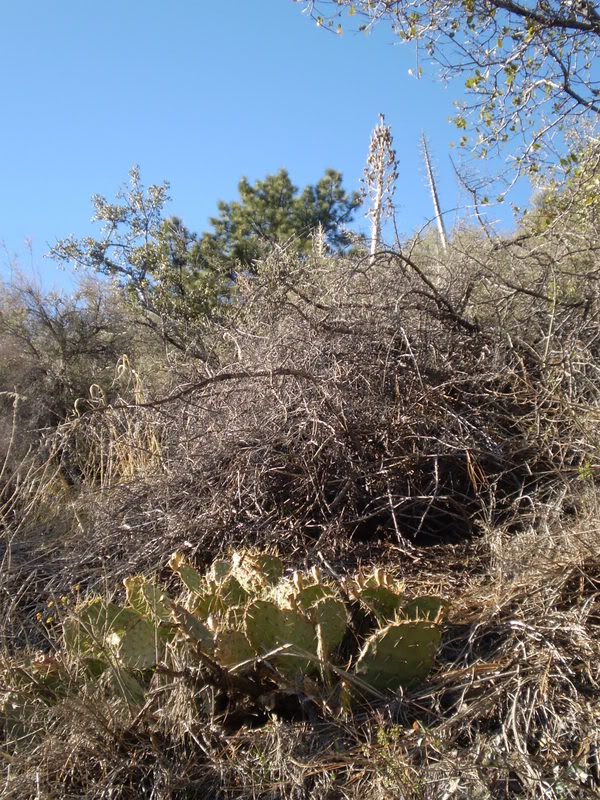 This shot shows some of the common flora, an Opuntia cactus and in the background the dry flowering head of an Agave.
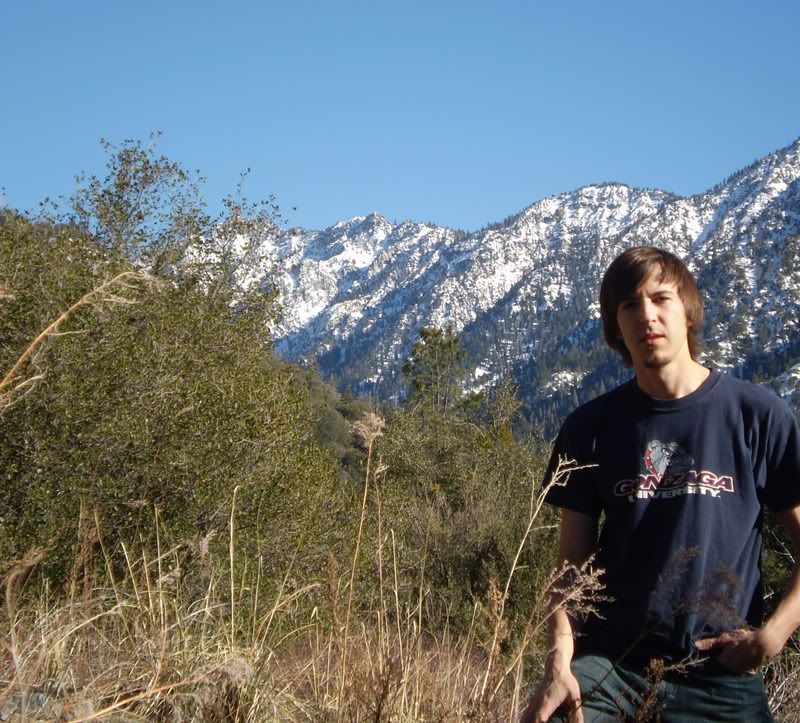 I don't know what I'd do with out the time-delay option. It is always interesting trying to find something to balance my camera on in the wilderness though.
 Looking back down at the valley of Mill Creek. The hike starts at the valley floor.
 The high mountains belong to the wild goats;
 In some of my rare moments of free time I have been reading St. Athanasius’ Letter to Marcellinus. The letter concerns mainly the Psalms, one of my favorite parts of Scripture, and I think what I read the other day in this text is one of the best and truest statements about the Psalms I have ever seen:
There is also this astonishing thing in the Psalms. In other books, those who read what the holy ones say, and what they might say concerning certain people, are relating the things that were written about those earlier people. And likewise, those who listen consider themselves to be other than those about whom the passage speaks, so that they only come to the imitation of the deeds that are told to the extent that they marvel at them and desire to emulate them. By contrast, however, he who takes up this book – the Psalter – goes through the prophecies about the Savior, as is customary in the other Scriptures, with admiration and adoration, but the other psalms he recognizes as being his own words. And the one who hears is deeply moved, as though he himself were speaking, and is affected by the words of the songs, as if they were his own songs. And for the sake of clarity of expression, do not hesitate, as the Apostle says, to repeat the very things they say…
I remember how years ago when I began praying the Psalms how I was often amazed by the fact that the Psalm put into words what I needed to say to God so much better than anything I could come up with. What a wonderful thing it is that in the middle of God’s Word we have this prayer-book for His people through which we can praise our Maker and receive much blessing from him.


