Showing posts with label Rembrandt. Show all posts

Saturday, December 25, 2010

Good Tidings of Great Joy


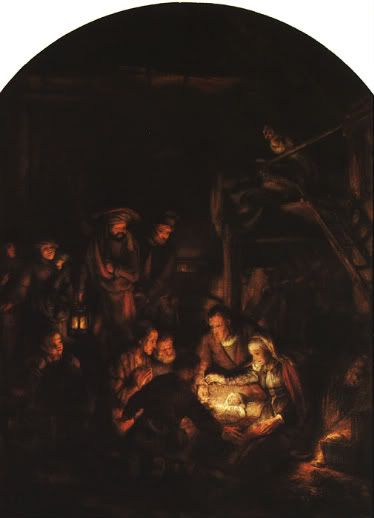
. . . He took to Himself a body, a human body even as our own. Nor did He will merely to become embodied or merely to appear; had that been so, He could have revealed His divine majesty in some other and better way. No, He took our body, and not only so, but He took it directly from a spotless, stainless virgin, without the agency of human father - a pure body, untainted by intercourse with man. He, the Mighty One, the Artificer of all, Himself prepared this body in the virgin as a temple for Himself, and took it for His very own, as the instrument through which He was known and in which He dwelt. Thus, taking a body like our own, because all our bodies were liable to the corruption of death, He surrendered His body to death in place of all, and offered it to the Father. This He did out of sheer love for us, so that in His death all might die, and the law of death thereby be abolished because, when He had fulfilled in His body that for which it was appointed, it was thereafter voided of its power for men. This He did that that He might turn again to incorruption men who had turned back to corruption, and make them alive through death by the appropriation of His body and by the grace of His resurrection. Thus He would make death to disappear from them as utterly as straw from fire.

- St. Athanasius (293-373 A.D.), from On the Incarnation

Tuesday, April 28, 2009

Where Credit is Due


You may have noticed that over the last couple of months I've used a lot of art in my posts. I guess Lent kind of put me in the mood to do some more "devotional" type posts and I find that a good painting often goes very well with a more devotional post. So I wanted to give credit to the source of most of the paintings I've put up on my blog and the source is my favorite painter, the great Dutch artist Rembrandt van Rijn. Rembrandt's art appears in posts from April 10th, 12th, 19th and 26th.

With my admiration of his work one would think that I would have read something about the life of Rembrandt but up until preparing to write this blog post I hadn't. And as with most subjects I want to be quickly educated on, my source was Wikipedia.

Rembrandt was born in Leiden in the Netherlands and lived from 1606 to 1669. He lost three of his four children to early deaths and also his wife, most likely to tuberculosis. The aspect of Rembrandt's life I was most interested to learn about was his religion. I had expected, with the amazing Biblical scenes he is known for, that Rembrandt's religious side would be explored in the article on Wikipedia but I found that not to be the case. In fact, Rembrandt seems to be a little mysterious spiritually. His father was part of the Dutch Reformed Church and his mother was Roman Catholic. I read one site that speculated that not much was known about Rembrandt spiritually because he didn't want to completely embrace or reject either the faith of his father or mother. Whatever the case may be, I think his paintings have been a spiritual blessing to many people.

Rembrandt is not the only artist that has shown up on my blog. I also like to occasionally use Gustave Dore's Bible illustrations among many other sources. But lately I've used a lot of Rembrandt so I wanted to focus on him in this post.

Sunday, April 26, 2009

Did Not Our Hearts Burn Within Us?


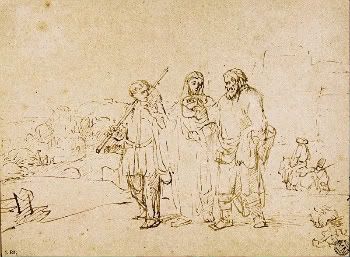
Another favorite Resurrection story of mine comes from the Gospel of Luke where we find two of Jesus' disciples walking to the village of Emmaus when they are joined by the Risen Christ Himself, but do not recognize Him at first. I like this story so much because I think it reveals how some of the disciples might have felt after the crucifixion and after they had heard news of the Resurrection from the women.

So they drew near to the village to which they were going. He acted as if he were going farther, but they urged him strongly saying, "Stay with us, for it is toward evening and the day is now far spent." So he went in to stay with them. When he was at table with them, he took the bread and blessed and broke it and gave it to them. And their eyes were opened, and they recognized him. And he vanished from their sight. They said to each other, "Did not our hearts burn within us while he talked to us on the road, while he opened to us the Scriptures?" - Luke 24:28-32
When the two disciples had reached Emmaus, and were refreshing themselves at the evening meal, the mysterious stranger who had so enchanted them upon the road, took bread and brake it, made himself known to them, and then vanished out of their sight. They had constrained him to abide with them, because the day was far spent; but now, although it was much later, their love was a lamp to their feet, yea, wings also; they forgot the darkness, their weariness was all gone, and forthwith they journeyed back the threescore furlongs to tell the gladsome news of a risen Lord, who had appeared to them by the way. They reached the Christians in Jerusalem, and were received by a burst of joyful news before they could tell their own tale. These early Christians were all on fire to speak of Christ’s resurrection, and to proclaim what they knew of the Lord; they made common property of their experiences. This evening let their example impress us deeply. We too must bear our witness concerning Jesus. John’s account of the sepulchre needed to be supplemented by Peter; and Mary could speak of something further still; combined, we have a full testimony from which nothing can be spared. We have each of us peculiar gifts and special manifestations; but the one object God has in view is the perfecting of the whole body of Christ. We must, therefore, bring our spiritual possessions and lay them at the apostle’s feet, and make distribution unto all of what God has given to us. Keep back no part of the precious truth, but speak what you know, and testify what you have seen. Let not the toil or darkness, or possible unbelief of your friends, weigh one moment in the scale. Up, and be marching to the place of duty, and there tell what great things God has shown to your soul.
-CH Spurgeon, Morning and Evening

Sunday, April 19, 2009

Rabboni!


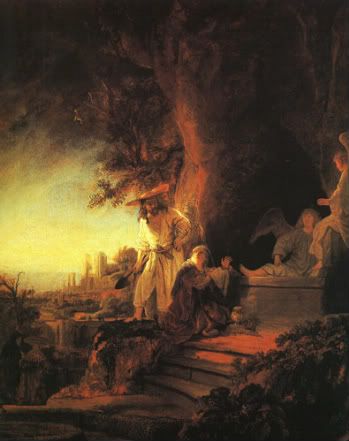
But Mary stood weeping outside the tomb, and as she wept she stooped to look into the tomb. And she saw two angels in white, sitting where the body of Jesus had lain, one at the head and one at the feet. They said to her, "Woman, why are you weeping?" She said to them, "They have taken away my Lord, and I do not know where they have laid him." Having said this, she turned around and saw Jesus standing, but she did not know that it was Jesus. Jesus said to her, "Woman, why are you weeping? Whom are you seeking?"Supposing him to be the gardener, she said to him, "Sir, if you have carried him away, tell me where you have laid him, and I will take him away." Jesus said to her, "Mary." She turned and said to him in Aramaic, "Rabboni!" (which means Teacher). - John 20:11-16
This Easter story, where Mary Magdalene exclaims "Rabboni!" has been one of my favorite Resurrection stories for a long time. I remember hearing this story read when my family would go to Easter sunrise services early in the morning on the banks of the Lewis River. I think what strikes me about this story is the almost palpable emotion of Mary who is at first described as weeping. I always imagined it being dark and Mary having tears in her eyes when she turned and failed at first to recognize her Lord. But Jesus calls her by name and Mary's one word reply of "Rabboni" is a single word of Scripture which has always affected me greatly.

I like what Calvin has to say in his commentary on the passage. On Jesus calling Mary by name Calvin writes, "That voice of the Shepherd, therefore, enters into Mary's heart, opens her eyes, arouses all her senses, and affects her in such a manner, that she immediately surrenders herself to Christ." On Mary's reply to Jesus, Calvin writes, "The efficacy of the address [Rabboni] is evident from this circumstance, that Mary immediately renders to Christ the honor which is due to him; for the word Rabboni is not only respectful, but involves a profession of obedience. Mary therefore declares, that she is a disciple of Christ, and submits to him as her Master. This is a secret and wonderful change effected on the human understanding, when God, enlightening her by his Spirit, renders her clear-sighted, who formerly was slow of apprehension, and, indeed, altogether blind. Besides, the example of Mary ought to serve the purpose of exhortation, that all whom Christ invites to himself may reply to him without delay."


Sunday, April 12, 2009

He Is Risen!


I am the resurrection and the life. Whoever believes in me, though he die, yet he shall live, and everyone who lives and believes in me shall never die.
-John 11:25-26

Friday, April 10, 2009

Christ: Sacrifice and Victor


Yet we must not understand that he fell under a curse that overwhelmed him; rather - in taking the curse upon himself - he crushed, broke, and scattered its whole force. Hence faith apprehends an acquittal in the condemnation of Christ, a blessing in his curse. Paul with good reason, therefore, magnificently proclaims the triumph that Christ obtained for himself on the cross, as if the cross, which was full of shame, had been changed into a triumphal chariot! For he says that "Christ nailed to the cross the written bond which stood against us . . . and disarmed the principalities . . . and made a public example of them" [Col. 2:14-15]. And no wonder! For "Christ . . . through the eternal Spirit offered himself," as another apostle testifies [Heb. 9:14]. From this came that transmutation of nature. But that these things may take root firmly and deeply in our hearts, let us keep sacrifice and cleansing constantly in mind. For we could not believe with assurance that Christ is our redemption, ransom, and propitiation unless he had been a sacrificial victim. Blood is accordingly mentioned wherever Scripture discusses the mode of redemption. Yet Christ's shed blood served, not only as a satisfaction, but also as a laver [cf. Eph. 5:26; Titus 3:5; Rev. 1:5] to wash away our corruption.

-John Calvin, Institutes 2.16.6