Showing posts with label Southern California. Show all posts

Monday, March 7, 2011

Two (small) peaks in one day - Morton & Zanja


I wanted to find a nearby peak to summit so after looking at google terrain maps for about an hour I decided to do two in one day. Both of these peaks were smaller than what I'm used to climbing but they were within an hour of where I live and both looked somewhat interesting. The combination of the two peaks also provided a decent physical challenge. The first climb up 4624 ft. Morton Peak was a 6 mile round trip hike with an elevation gain of about 1300 ft, the second climb up 3543 ft. Zanja Peak was about 4 miles round trip with an elevation gain of about 900 ft. I headed to the base of Morton Peak in the San Gorgonio Mountains in the morning and within two hours had summited, explored around the fire look-out tower on top and hiked back down to my car. I drove about 20 minutes to Yucaipa Regional Park to the trailhead of my second hike. From there I climbed Zanja Peak which is the highest point in the Crafton Hills to the north of the town of Yucaipa where I go to church.

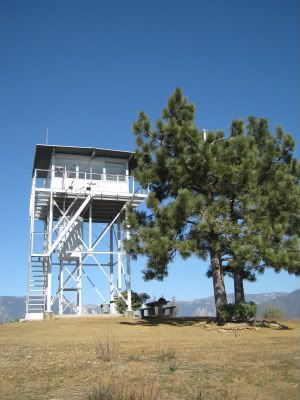
Approaching Morton Peak's summit the fire look-out on top comes into view.

An eagle soars above Mill Creek Valley

At the summit of Morton Peak, the fire look-out. Unfortunately the platform was firmly locked up so I couldn't get up there.

Summit of Morton Peak

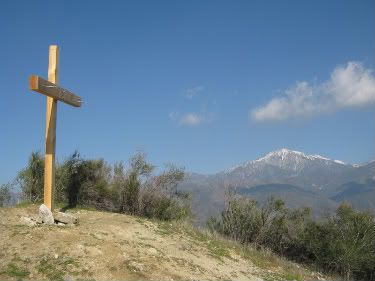
Climbing up Zanja Peak I came across this cross on a lower hill. Mt. San Bernardino in the background.

Looking down on Yucaipa from Zanja Peak summit. I go to church down there.

And the summit markers. . .


Monday, February 21, 2011

Catalina Island


The second place I checked out during my recent time off from clerkship rotations was Santa Catalina Island. Catalina is one of the Channel Islands, about 22 miles long and about 20 miles off the coast of Los Angeles. As with the Salton Sea, the Channel Islands off of Southern California have intrigued me since grade school. I first heard of these islands in 3rd or 4th grade when I read the children's book Island of the Blue Dolphins. For the last couple of years in medical school every time I've gone to the beach to surf or relax I've seen Catalina Island in the distance. So the last time I was at the beach I decided I would take the ferry out to the Island and then hike to the highest point - Mt. Orizaba.

I got on the ferry at Long Beach at nine in the morning and over an hour later made landfall at the harbor of Avalon, one of two small towns on the island. Avalon is a very compact and interesting town where the majority of inhabitants drive golf carts as their primary vehicle. After getting my hiking permit at the Catalina Conservancy Office I went to track down a bus that would take me about 5 miles into the interior to get to the start of the trail to climb Orizaba. But upon visiting the offices of both bus companies on the island I came to the seemingly devastating conclusion that I would not be climbing Orizaba that day as there were no buses running into the interior. I thought briefly about trying to make it to the summit hiking from Avalon but I knew if I tried such a thing - over 20 miles round trip - it would be dark by the time I hiked back into town and I might miss the last ferry back to Long beach.

The islanders were of a friendly sort though and one older man who saw me looking at my map simply suggested I hike up into the hills around Avalon. As I climbed into the hills above the town I realized that this day would not be a disappointment. I was amazed by the beauty of my surroundings as I hiked along the crest of the island. The Pacific Ocean stretched into the distance with San Clemente Island in the foreground to the southwest and to the northeast was the blue of the San Pedro Channel and the snow-capped mountains of Southern California in the distance. While it was obvious that this island was a much more arid environment than my home in Western Washington I was surprised by the lush growth of a wide variety of shrubs, trees and plants as I hiked around.

Dodecatheon sp. - lots of these at the lower elevations.

Looking to the north - some interesting trees and the southern Californian mainland in the distance.

My initial goal had been Mt. Orizaba, the highest point on the left. Maybe next time.

A green hillside on the southwest side of the island. If you look closely you can see a lot of Prickly Pear cacti (Opuntia) on the hillside.

Looking to the northwest. The town of Avalon in the foreground. In the distance is snow-capped Mt. Baldy, highest point in Los Angeles county.

After hiking for about five hours I found a great place to watch the sun set over the Pacific. I had brought City of God with me so I read an interesting chapter where Augustine recounted various healing miracles he had witnessed during his ministry. The sunset was quite impressive and it was dark by the time I made it back to town - just in time for the 6:15 ferry.

Sunset from Catalina

My ride back to the mainland.

Friday, February 11, 2011

Salton Sea


During my two weeks of working on research and having a fairly open schedule I decided to check out a couple of nearby places that have always intrigued me. The first of these was the Salton Sea, about an hour east of Loma Linda, out in the desert past Palm Springs. I had first heard of the Salton Sea from a teacher in high school and it had interested me ever since because of how it came into existence. This salt lake, the largest body of water in California, was created by accident when floodwaters overran irrigation ditches in 1905. Before that this vast lake had been a depression, the lowest point of which was 5 ft higher than the lowest point in North America which is in Death Valley at 282 ft. below sea level.
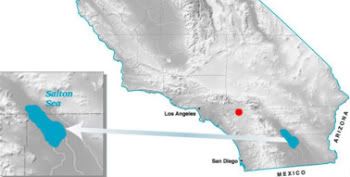
Map of Southern Califonia with Salton Sea pop-out.
Red dot is approximate location of Loma Linda.

I had never met anyone who had been out to the Salton Sea and everything I read on the internet about it made me think it probably wouldn't be the nicest place to visit but I had some time on my hands so I decided to check it out. My first stop was Salton Sea Beach on the western side of the lake. This town came close to fitting my expectations of finding a post-apocalyptic-wasteland-esque environment around the lake. Salton Sea Beach, like some other places I stopped, revealed that this place was way past its heyday when it was marketed as a resort location. This town also revealed why the Salton Sea probably failed as a vacation destination. When I got out of my car at the "marina" I was first struck by the overwhelming stench of dead fish. I walked down to the water to find thousands upon thousands of dead fish, tilapia I think, floating along the shore. I think this must be a common thing here because many websites I read before my trip named fish die-offs as a problem.

West side of the sea at Salton Sea Beach, dead fish floating in water.

Abandoned building at Salton Sea Beach.

I drove all the way around the Lake which took a couple of hours. I figured maybe I could at least enjoy a good sunset at Salton Sea State Park on the east side of the lake. I got to the park about an hour before sunset and went for a brief hike along the beach. There was a lot of water fowl and once again a lot of dead fish.

Flock of birds at Salton Sea State Park on the east side.

Just before sunset I prayed a psalm at one of the conveniently placed picnic tables near the shore. As the sun sank below the San Jacinto Mountains, a chill, dank breeze blew in off the surface of the sea and I was almost overwhelmed by the heavy stench it carried. It had been an interesting day. I will probably never go back to the Salton Sea unless forced to but I'm glad I got to see it.

Sunset over the Salton Sea

Monday, December 20, 2010

Mammoth/Job/Irenaeus/Pascal


I know that my redeemer lives

-Job


To inaugurate what may be the last real Christmas Break of my life I headed up with some friends to Mammoth Mountain for a weekend of snowboarding. Mammoth is high in the Sierra Nevada in central California and is the most impressive ski resort I've ever seen. We got a good deal on a slopeside condo and our plan was to snowboard all day Saturday and Sunday. Four-and-a-half hours north of Loma Linda we drove into heavily falling snow in Mammoth Lakes, California as we arrived at the condo. The next morning we arose early to be the first on the lift to snowboard down untracked powder. The chest-deep powder was a challenge that morning but as the runs became more tracked-out and I adapted to the powder the day turned into an excellent day of snowboarding. The snow did not quit falling that day and fell all night Saturday night. When we headed up the slopes again Sunday morning we found that only two of the twenty-eight lifts were open because of wind and snow. It turns out that the storm we weathered in Mammoth has been part of the snowiest December ever recorded there (since record-keeping was started in 1969.) Between Friday and Sunday when we left the storm dumped 6 to 10 feet of snow.


I forgot my camera but snapped a few photos on the way out of town with my iPhone:

Some skiers make their way to the lift.

The road out of town, speed limit sign on right.

Digging one of our cars out of the snow.


After a full day of snowboarding Saturday we gathered, a group of 10, for a time of devotion, focusing on Old Testament prophecies concerning the incarnation, life and atoning death of Jesus Christ. We also read the Christmas story from Matthew and Luke. Some of the prophecies we read and meditated on were very familiar to me such as that from Genesis 3:15, ". . . he shall bruise your head, and you shall bruise his heel," and those from Isaiah and Micah. But I had not realized that the Book of Job also contains some words which seem to be Messianic in character. And certainly commentators such as Wesley and Matthew Henry saw some of these words as directly prophetic concerning Christ. It was Job 9:32-35 which especially affected me. In this section Job expresses his desire for an Arbiter between him and the holy and seemingly unapproachable God of the universe. As Job expresses his desire he says, "There is no arbiter between us, who might lay his hand on us both (9:33)." Job confesses his need for an Arbiter between himself and God, the need of every sinner. But Job does not stop here. In 16:19 he confesses his hope that he does indeed have a "witness" in heaven, "Even now, behold, my witness is in heaven, and he who testifies for me is on high." In this verse Job seems to fit with the Old Testament saints mentioned in Hebrews 11 where the author of that book writes, "These all died in faith, not having received the things promised, but having seen them and greeted them from afar, and having acknowledged that they were strangers and exiles on the earth (11:13)." Therefore, from afar, Job sees and greets the One who is his Arbiter and Witness in Heaven, the Lord Jesus Christ, who is the "one mediator between God and men (1 Tim 2:5)." Later, in a statement that in my opinion points to Christ's incarnation and Job's eventual resurrection, (although the text note in my ESV Study Bible doesn't jump to that conclusion as it says, "Because of Job's earlier laments and the difficulty of the Hebrew in v. 26, interpreters have questioned the likelihood that Job is expressing in these verses a belief that God will redeem him after death."), Job wonderfully proclaims, "For I know that my Redeemer lives, and at the last will stand upon the earth. And after my skin has been thus destroyed, yet in my flesh I shall see God, whom I shall see for myself, and my eyes shall behold, and not another (Job 19:25-27a)." Job knew that he would, in the flesh, see his Redeemer, the One who said, "Whoever has seen me has seen the Father (John 14:9b)."


Job's desire for an Arbiter between himself and God, one who could, "lay his hand on us both," reminded me of something I had just read from St. Irenaeus last week. He wrote, concerning Christ:

[In this way] He attached and united man to God. Had man not vanquished the enemy of man, the enemy would not have been justly vanquished. On the other hand, had it not been God who granted salvation, we could never have possessed it securely. And if man had not been united to God, he could never have become a partaker of incorruptibility. It required the Mediator of God and men, through His kinship with both, to bring back both to friendship and concord, presenting man to God, revealing God to man.

During Advent as we prepare to celebrate the Incarnation of our Lord and also look forward to His glorious Parousia, it is good to be reminded of the necessity of God the Son becoming fully and truly man to redeem sinners. Christ's Incarnation was not some arbitrary choice of God in determining how He would save sinners but it was necessary and the only fitting manner in which God would accomplish His sovereign purpose.


When I arrived back in Loma Linda I opened my copy of Pascal's Pensées, which I had recently purchased and came across a quote which fit very well with our recent devotional time focusing on the prophecies concerning Christ. Pascal wrote:

If a single man had written a book foretelling the time and manner of Jesus' coming and Jesus had come in comformity with these prophecies, this would carry infinite weight.


But there is much more here. There is a succession of men over a period of 4,000 years, coming consistently and invariably one after the other, to foretell the same coming; there is an entire people proclaiming it, existing for 4,000 years to testify in a body to the certainty they feel about it, from which they cannot be deflected by whatever threats and persecutions they may suffer. This is of a quite different order of importance.


Tuesday, September 7, 2010

Giant Watermelon


Growing up in Southwest Washington, my dad always had a great vegetable garden. There was always ample corn, sugar snap peas, tomatoes of various kinds, squash, sun flowers, carrots, asparagus, brussels sprouts and many other kinds of vegetables. But one thing my brothers and I always wanted to grow was a watermelon. We planted the seeds year after year which usually yielded a decent looking plant. Some years there would even be an attempt at the formation of an actual melon. But at best all we ever got was a small melon which would never ripen and usually cracked open and rotted.

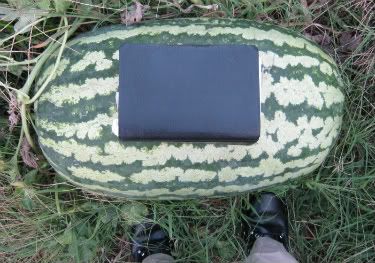
I recently moved into a house with some classmates and one of them planted a small vegetable garden in the back yard. One of the things he planted was watermelon. So in the future when I'm trying to come up with one or two positive aspects of living in Southern California I can say that at least you could grow watermelon there. I'll still gladly take the watermelon-poor climate of western Washington over So-Cal any day.


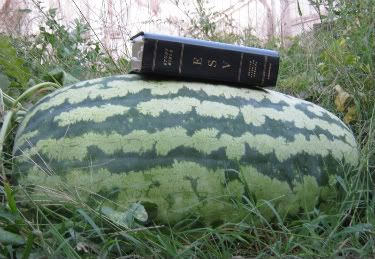
The ESV Study Bible is for size comparison. This is the biggest Bible I've ever owned. The melon measures over 2 feet in length.


Wednesday, July 21, 2010

San Bernardino


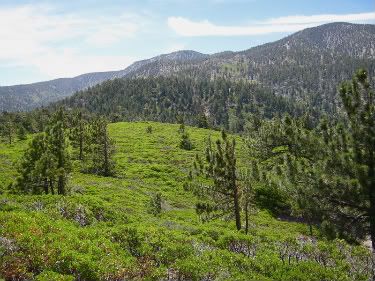
Yesterday I climbed another mountain with the same friend from church I climbed the last one. This time our goal was the 10,649 ft summit of Mt. San Bernardino. The climb was 16 miles round trip with a 4,600 ft elevation gain. Mt. San Bernardino is the most prominent peak visible from the Inland Empire where I live and go to school. I've wanted to climb it for a long time and I was not disappointed by the hike.

About halfway up, looking southeast toward the summit.

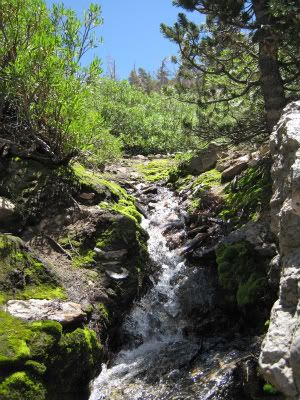
A mountain stream.

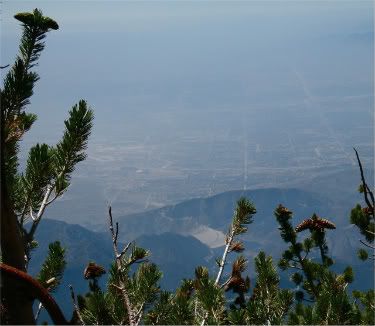
This picture was taken looking west from near the summit. Through the haze you can see the grid of streets in the cities of the Inland Empire, the street at center is Baseline. There's an interesting monument near the top dedicated to Col. Henry Washington, a surveyor who erected a marker, an "Initial Point," near the top of the mountain in 1852. This marker was used to partition all of the land in Southern California in a rectangular system. You can read the interesting story here.

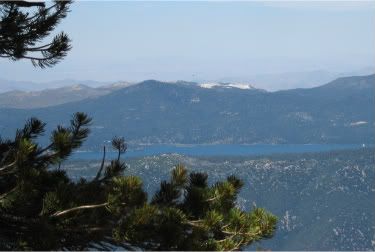
Looking north to Big Bear Lake. The solar observatory on the lake is visible as a white dot on the right.

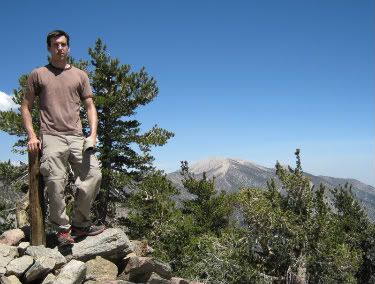
At the summit. Mt. San Gorgonio, highest point in southern California behind me. I climbed it last September.

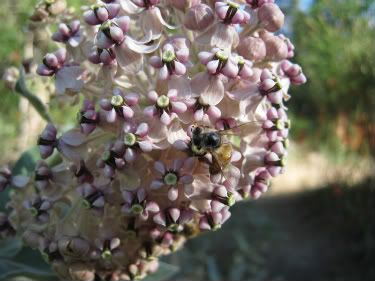
Coming down I found this patch of interesting flowers very popular with the honey bees.


"You will find something far greater in the woods than you will find in books. Stones and trees will teach you that which you will never learn from masters."

- Bernard of Clairvaux, the mountain's namesake


Sunday, July 11, 2010

San Jacinto


On Saturday I climbed the last of the "Three Saints" - the three highest peaks in the mountain ranges of Southern California. Back in September of '08 I climbed Mt. San Antonio (Old Baldy), and in September of '09 I climbed Mt. San Gorgonio. San Jacinto Peak at 10,834 feet was the last of the three for me. I went with a fellow parishioner from Christ's Church - Anglican, with whom I've hiked before. The climb was an easy ascent of about 2300 ft over about five and a half miles.

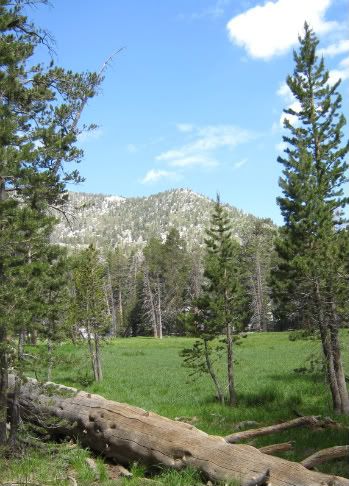
A grassy meadow in the San Jacinto Mountains.


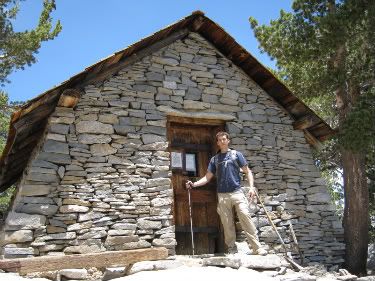
This hut was built near the summit in 1933 by the Civilian Conservation Corps. Inside are emergency supplies and journals that have been written in by climbers.

Summit of San Jacinto Peak

The Summit Marker


Thursday, June 24, 2010

Hulda Crooks


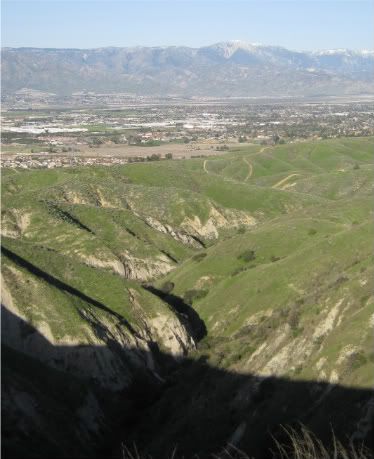
South of Loma Linda, California, where I'm in medical school there are miles and miles of trails in some dry, grassy hills. The hills are accessed at Hulda Crooks Park, named after a Seventh-day Adventist woman who was an avid mountaineer who climbed to the summit of Mt. Whitney, the tallest peak in the lower 48, at the age of 91. I've come to have a great appreciation for these hills and will often take my Bible, a water bottle and some granola bars up with me for some time in prayer and reading. I also like to take my camera up so here are some photos taken over a few months of hiking up in the Loma Linda South Hills.

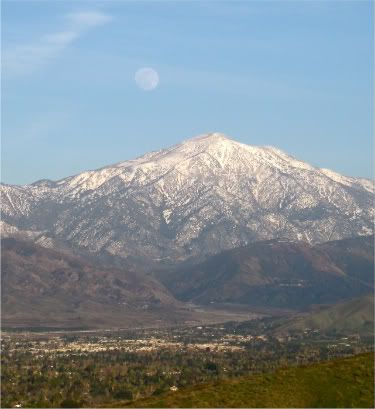
Moonrise over Mt. San Bernardino, looking east. The city of Redlands in the foreground.
There are lots of interesting canyons in the hills. Looking north toward San Bernardino.

In Spring the hills briefly come alive with a lot of interesting plant life.

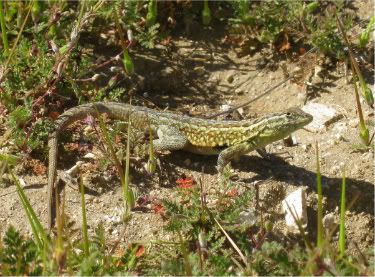
Lizards seem to be the predominant animal inhabiting the hills. They are very difficult to catch or get close enough to for a good photograph.

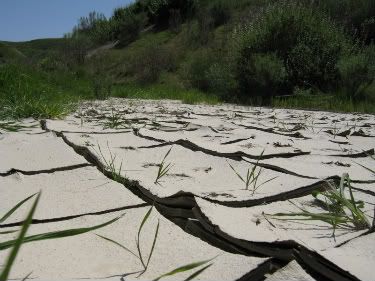
This year was very wet. Here is some dried-out mud with deep cracks in it at the bottom of what must have been a good-sized pond.
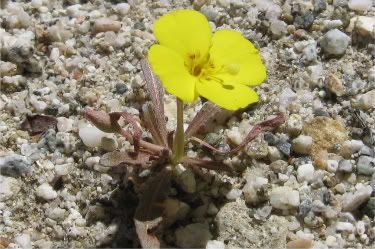
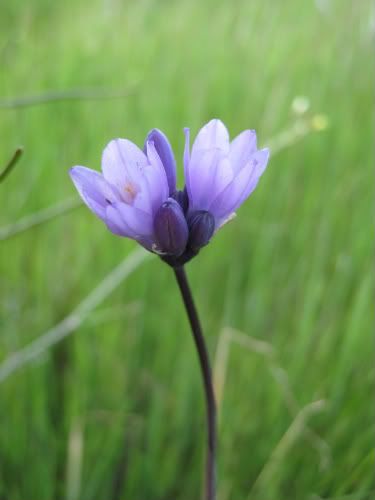
This plant was in the bottom of a dried-out creek bed. The flower is almost as large as the plant itself.
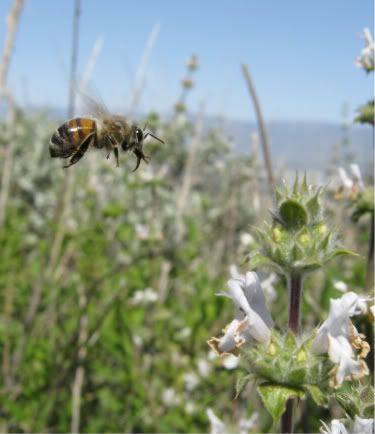
A honey bee in mid-flight.

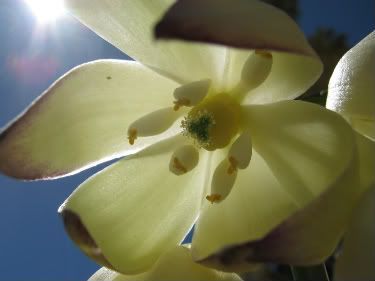
A close up of the flower of a yucca, growing wild in the hills.

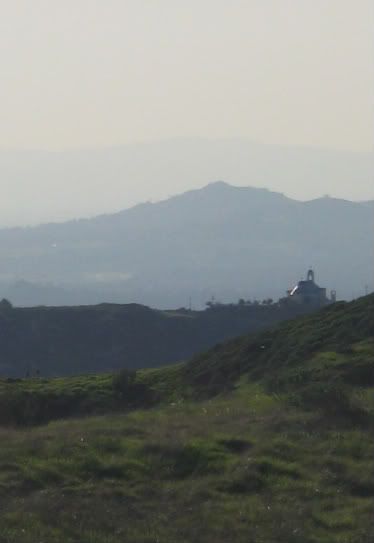
Looking south toward Riverside, a Coptic Church in the distance.


Saturday, April 24, 2010

He giveth snow like wool


Lacking inspiration to write about anything else at the moment I’ll reflect on this year’s snowboarding, a sport I’ve grown to love more each year for the last five or six years. Prior to that time, from when I was 12 or 13 years old, I was a skier and would usually go up a couple of times a year. I did more snowboarding this year than any previous year.


This year’s snowboarding started with my Christmas break when I went home to Southwest Washington state. I snowboarded Mt. Hood at Ski Bowl and Mt. Hood Meadows with my younger brothers and various friends:


Looking up at Mt. Hood at dusk from Ski Bowl.

Lots of powder on the upper runs at Ski Bowl at night.

Sunset from Mt. Hood Meadows


Unfortunately I have no pictures but I also spent a rainy New Year’s Eve and early New Year’s Day on Mt. Hood with a brother and a friend. We snowboarded in the sometimes pouring rain which was a new experience for me. We made a fun time of it though trying to hone our jumping skills and enjoying the firework show at midnight on the mountain.


When I returned to California I made three trips up to Snow Valley near Big Bear in the mountains north of Loma Linda and the Inland Empire. The mountains in Southern California got more snow this year than in a long time so the snowboarding has been better than usual down here this year.

Mountains of fresh snow in a gas station parking lot as we made our way to Snow Valley.


To cap off the year’s snowboarding I made a trip up to Mammoth Mountain a couple of weeks ago. We left Loma Linda at 3AM, made it to Mammoth in time for the lifts to open, left at 4PM when the lifts closed and were back home in Loma Linda around 9:30.

Top of the Sierra, Mammoth Mountain