Showing posts with label Jonathan Edwards. Show all posts

Saturday, May 22, 2010

The main source of mischief

Spiritual pride is the main door by which the devil comes into the hearts of those who are zealous for the advancement of Christianity.

It is the chief inlet of smoke from the bottomless pit, to darken the mind and mislead the judgment.

It is the main source of all the mischief the devil introduces, to clog and hinder a work of God.

Spiritual pride tends to speak of other persons’ sins with bitterness or with laughter and levity and an air of contempt. But pure Christian humility rather tends either to be silent about these problems or to speak of them with grief and pity.

Spiritual pride is very apt to suspect others, but a humble Christian is most guarded about himself.

He is as suspicious of nothing in the world as he is of his own heart.

The proud person is apt to find fault with other believers, that they are low in grace, and to be much in observing how cold and dead they are and to be quick to note their deficiencies.

But the humble Christian has so much to do at home and sees so much evil in his own heart and is so concerned about it that he is not apt to be very busy with other hearts.

He is apt to esteem others better than himself.

—Jonathan Edwards, “Thoughts on the Revival,” Works (Edinburgh, 1979), I:398-400

Saturday, December 26, 2009

Jonathan Edwards: The Necessity of the Incarnation


Christ became incarnate, or, which is the same thing, became man, to put himself in a capacity for working out our redemption. For though Christ, as God, was infinitely sufficient for the work, yet to his being in an immediate capacity for it, it was needful that he should not only be God, but man. If Christ had remained only in the divine nature, he would not have been in a capacity to have purchased our salvation; not from any imperfection of the divine nature, but by reason of its absolute and infinite perfection: for Christ, merely as God, was not capable either of that obedience or suffering that was needful. The divine nature is not capable of suffering; for it is infinitely above all suffering. Neither is it capable of obedience to that law which was given to man. It is as impossible that one who is only God, should obey the law that was given to man, as it is that he should suffer man’s punishment.


-Jonathan Edwards (1703-1758), from his Works.

Wednesday, April 22, 2009

Ten Lessons From Great Christian Minds

I thought this was a pretty cool post from the blog Between Two Worlds. I've read works from all of these men and Augustine, Calvin, Edwards, a Kempis, Wesley and Dostoyevsky have all done a lot to shape my thinking. The one Christian writer not on the list who has also had a big influence on me is John Bunyan and his work, The Pilgrim's Progress.
From philosophy professor
James Spiegel:
  1. Augustine (5th century): Remember that you are a citizen of another kingdom.
  2. Martin Luther (16th century): Expect politicians to be corrupt.
  3. Thomas Aquinas (13th century): God has made himself known in nature.
  4. John Calvin (16th century): God is sovereign over all, including our suffering.
  5. Jonathan Edwards (18th century): God is beautiful, and all beauty is divine.
  6. Thomas a’Kempis (15th century): Practice self-denial with a passion.
  7. John Wesley (18th century): Be disciplined and make the best use of your time.
  8. Fyodor Dostoevsky (19th century): God’s grace can reach anyone.
  9. Dietrich Bonhoeffer (20th century): Beware of cheap grace.
  10. Alvin Plantinga (21st century): Moral virtue is crucial for intellectual health.

Wednesday, February 25, 2009

Ash Wednesday

for dust thou art, and unto dust shalt thou return

O sinner! Consider the fearful danger you are in: 'tis a great furnace of wrath, a wide and bottomless pit, full of the fire of wrath, that you are held over in the hand of that God, whose wrath is provoked and incensed as much against you as against many of the damned in hell; you hang by a slender thread, with the flames of divine wrath flashing about it, and ready every moment to singe it, and burn it asunder; and you have no interest in any mediator, and nothing to lay hold of to save yourself, nothing to keep off the flames of wrath, nothing of your own, nothing that you ever have done, nothing that you can do, to induce God to spare you one moment...

...And now you have an extraordinary opportunity, a day wherein Christ has flung the door of mercy wide open, and stands in the door calling and crying with a loud voice to poor sinners; a day wherein many are flocking to him, and pressing into the kingdom of God; many are daily coming from the east, west, north and south; many that were very lately in the same miserable condition that you are in, are in now an happy state, with their hearts filled with love to him that has loved them and washed them from their sins in his own blood, and rejoicing in hope of the glory of God. How awful is it to be left behind at such a day! To see so many others feasting, while you are pining and perishing! To see so many rejoicing and singing for joy of heart, while you have cause to mourn for sorrow of heart, and howl for vexation of spirit! How can you rest one moment in such a condition?

-Jonathan Edwards, Sinners in the Hands of an Angry God

Tuesday, January 13, 2009

The Best Biography I've Ever Read


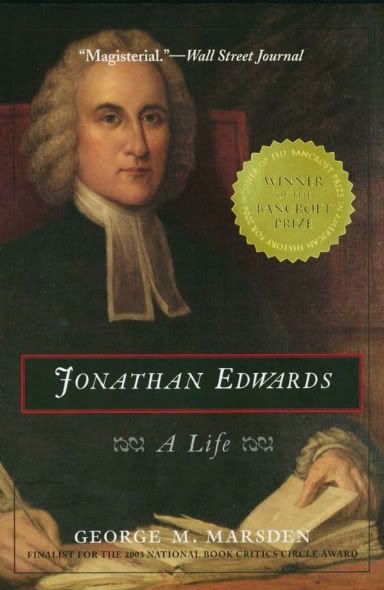
I finished the Jonathan Edwards biography I was reading over Christmas break and it's one the best biographies I've ever read. I would highly recommend it to anyone at all interested in church history. At times it was like reading a devotional although it is not all encouraging stuff as the Great Awakening brought not only conviction of sin and conversions to New England but also a lot of controversy. This biography also turned me into a fan of Jonathan Edwards and has challenged the Arminianism that I've held so dear for a good number of years now. Inspired by the biography, I purchased a copy of Edwards' The Life of David Brainerd and also his The Freedom of the Will. I'm reading The Freedom of the Will with a Calvinist friend here at the medical school. When I say that my Arminianism has been challenged, I say it with much trepidation. Being convinced otherwise on a point like predestination is something that I take very seriously and not something that I ever thought I would change my mind on. But I realize that if anyone will change my mind, it will be Jonathan Edwards. I would like to end this post with a good Edwards quote but I loaned out my copy to a fellow parishioner at Christ's Church. Updates will follow.


Sunday, January 4, 2009

"The very essence of reality"

The Charity sermons, simple and practical as they were, stood close to the heart of Edwards' theological enterprise. The very essence of reality, he emphasized in his more abstruse theological notebooks, was the intertrinitarian love of the Father, Son and Holy Spirit. The only possible reason for such a perfect being to create the universe was to extend that love to other, imperfect, beings. So, as he explained briefly to the parishioners of the river town: "There in heaven this fountain of love, this eternal three in one, is set open without any obstacle to hinder access to it. There this glorious God is manifested and shines forth in full glory, in beams of love; there the fountain overflows in streams and rivers of love and delight, enough for all to drink at, and to swim in, yea, so as to overflow the world as it were with a deluge of love."
- From George M. Marsden's biography, Jonathan Edwards, A Life.

Tuesday, December 30, 2008

Christmas Break Reading

I went into Christmas Break this year disappointed that there weren't any books high on my reading list. But thankfully, through the kindness of some friends, I have been supplied with some excellent material...

A good friend from Loma Linda has been reading Marsden's biography of Jonathan Edwards and he was kind enough to allow me to borrow it over the break. Marsden is such a great writer that I think I would enjoy reading about almost anything if it were written by him. But in the first third of his detailed and lengthy biography, Marsden has also succeeded in making me a great fan of Jonathan Edwards. It's sad that in our left-wing propaganda infused public schools the only thing most students ever hear of Edwards is his "Sinners in the hands of an angry God," which, by the way, I have heard is a great sermon. Edwards did not downplay God's wrath, as I think many modern preachers are mistaken to do, but he also did not downplay God's amazing goodness and love as seen in the death and resurrection of our Lord Jesus Christ. As I read Marsden's biography I have an idea for a blog-post seemingly every other page so I'm sure I'll write more on it later.

The second thing I've been reading this break was a Christmas present from my friend, Josh Monen, who, on Friday, asked a wonderful girl to marry him. Congratulations Josh. Josh was thoughtful enough to find me a book that you wouldn't find in any bookstore and one that would normally only be owned by a very select population. It covers a subject that I am very interested in though, Apostolic Lutheranism. It is actually the history of a single church in my county, located about six miles from my house in Hockinson. The book also covers a little of the history of the Laestadian movement in general and I was very excited to see that it has a little to say about a part of the history that I am very interested in but have had a hard time finding information on. As with the Edwards' book, I'm sure more blog posts will follow.


Tuesday, November 11, 2008

Jonathan Edwards and Positive Agency

dsMany of my friends here at Loma Linda are big fans of the well-known writer and pastor of Bethlehem Baptist Church in Minneapolis, John Piper. One them gave me some of his sermons on a CD last year and I was quite impressed by what I heard. Since then I've been a somewhat regular reader of Piper's blog and have enjoyed what I've read there. My introduction at Loma Linda was not my first to Piper though. When I was at Asbury, Piper was one of "those Calvinists," with whom we loved to disagree. Even at Asbury, the little I knew about Piper caused me to respect him in the same way I respected Al Mohler. I knew I had some serious disagreements and I was convinced that they would probably see my form of Christianity as deficient but I respected them both as bold defenders of Biblical Christianity.

On Sunday, after a week of midterms I was at Barnes and Noble to get a book on surfing but I also decided to browse the Christian section. Piper's Desiring God, a book I've wanted to check out for a while, stood out to me on the shelf so I decided to pick that up also. I've read the first two chapters so far and especially appreciated his chapter on Conversion where he takes on the idea that you can just say a little prayer, and experience no repentance or change in your life and yet somehow that makes you a Christian. But as I've read I've also struggled with a Calvinistic idea that I find very problematic: the complete and utter determinism by God of all events in history that Calvin seems to imply in his Institutes and that Calvinist leaders like Piper seem to embrace today. This blog post is not going to be any sort of in-depth exploration of the matter as I don't have the time to spend on it. But I was impressed by something I read in one of the appendices to Piper's Desiring God yesterday.

The appendix is entitled, "Is God Less Glorious Because He Ordained That Evil Be?" And the section that I found helpful is called, "Is God the Author of Sin?" Piper quotes Jonathan Edwards quite a bit in this section and adds in some of his own analysis:

Is God the author of sin?

Edwards answers, "If by 'the author of sin,' be meant the sinner, the agent, or the actor of sin, or the doer of a wicked thing. . .it would be a reproach and blasphemy, to suppose God to be the author of sin." But he argues, willing that sin exist in the world is not the same as sinning. God does not commit sin in willing that there be sin. God has established a world in which sin will indeed necessarily come to pass by God's permission, but not by His "positive agency."

God is, Edwards says, "the permitter. . .of sin; and at the same time, a disposer of the state of events, in such a manner, for wise, holy and most excellent ends and purposes, that sin, if it be permitted. . .will most certainly and infallibly follow."

He uses the analogy of the way the sun brings about light and warmth by its essential nature, but brings about dark and cold by dropping below the horizon. "If the sun were the proper cause of cold and darkness," he says, "it would be the fountain of these things, as it is the fountain of light and heat: and then something might be argued from the nature of cold and darkness, to a likeness in the nature in the sun." In other words, "sin is not the fruit of any positive agency or influence of the most High, but on the contrary, arises from the withholding of his action and energy, and under certain circumstances, necessarily follows on the want of his influence.
I have no disagreement with the way Edwards presents sin here and how sin relates to God's "positive agency." It is the idea that God has "positive agency" in the real moral evil of this world that causes me to have serious doubts about what I have understood to be the Calvinist position. Piper frequently reminds us in Desiring God that we should have a God-centered and not a man-centered view of the universe. With this I completely agree but I think part of having this God-centered view is not embracing a theology which in any way infringes upon an important attribute of God, His goodness. And I realize that as sinful humans we have a deficient understanding of what real goodness is but at the same time when we call God "good" that idea of "goodness" must have a strong relation to what we would normally think of as "goodness" or else it is completely meaningless to say that God is good. I know that many of the things that might seem evil to us in this world are really a blessing or a judgment from God but at the same time I don't believe that there is anything in Scripture which would ever cause me to believe that God has any "positive agency" in the horrendous moral evils committed by free creatures in the universe.

I look forward to continuing on in Desiring God, a book which one of my housemates called the most influential book in his life, second only to the Bible. I also expect more theological conversations with my classmates and more posts like this one as a result of my reading.