-John Calvin, Commentaries - John 12:12
Sunday, April 1, 2012
Calvin: Christ's design on Palm Sunday
-John Calvin, Commentaries - John 12:12
Friday, February 10, 2012
Random Update #8: Neurology → Nephrology
2. Today I started working in the Nephrology clinic and that's where I'll be for the next month except for a week of leave I'm taking starting on the 18th.
3. I've occasionally been able to read a few pages of the Bede's Ecclesiastical History of the English Nation. It's an amazing work of history and of literature. Two men about whom I knew little were St. Augustine of Canterbury (d. AD 604) (not to be confused with "of Hippo") and Pope Gregory the Great (AD 540 - 604). Both of these men played a great role in the evangelization of my ancestors and the formation of the English Church. For that I am grateful to them and more so to God who chooses such sinners for tasks so great.
| A snowy drive to work |
5. While I haven't been writing on my blog I have gotten myself involved in a facebook debate about baptism with a bunch of Lutherans (with whom I mostly agree) and Baptists (with whom I mostly disagree). And by Baptist I mean "Non-denominational," "Charismatic," "Pentecostal," and also all those with the honesty just to call themselves "Baptist." With that said I know a lot of great Christians who are Baptists (heck, just look at my favorite Christians blogs on the right-hand of your screen - 4 out of the 7 are Baptists). But the debate I've been in has made me examine my own thoughts on baptism, and to be honest it's something I've probably tried not to think too much about in order to avoid debates with a good percentage of my Christian friends. A friend challenged me on a statement I made denying the intrinsic efficacy of baptism as a means of grace. He confronted me not with some systematic theology and not with some sappy platitude but with a fairly clear and plain-sounding statement from God's word: "Baptism, which corresponds to this, now saves you, not as a removal of dirt from the body but as an appeal to God for a good conscience." Hmm... Doesn't really seem to fit with what I had written.
6. St. Augustine wrote: "For whatever unbaptized persons die confessing Christ, this confession is of the same efficacy for the remission of sins as if they were washed in the sacred font of baptism." (City of God, Book XIII, chapter 7.)
![]() |
| "Baptism of St. Augustine" (of Hippo) - Troyes |
8. On the subject of Baptists and scriptural fidelity, I recently visited a nearby "Non-denominational" (read Baptist) church because they had a Saturday night service and it was my only chance to go to church that week. It was a pretty hip place, lots of 20-somethings with cool-looking clothes and the very latest in praise music. But I was thoroughly unimpressed by the preaching, which was topical and during which a very few Bible verses were used (likely misused) in making the preacher's somewhat questionable points. And then I started thinking about how the Lutheran church I sometimes attend when I'm in the Portland area and the Anglican church I like to worship at in Olympia have sermons that are absolutely saturated with Scripture. I can also think of quite a few other Non-denominational churches I've been to where very little Scripture is read during the service. The thing that gets me is that it's often these same people who will accuse Lutherans and Anglicans of being too beholden to "tradition" while they supposedly simply follow the Word of God.
9. Much of the best, most Scripture-saturated and Christ-centered preaching I've ever heard was at Cornerstone Bible Church (Baptistic in theology) in Riverside, California during medical school. It's a complicated world we live in.
Monday, November 22, 2010
Who Maketh Thee to Differ?
To distinguish here means to render eminent. Augustine, however, does not ineptly make frequent use of this declaration for maintaining, in opposition to the Pelagians, that whatever there is of excellence in mankind, is not implanted in him by nature, so that it could be ascribed either to nature or to descent; and farther, that it is not acquired by free will, so as to bring God under obligation, but flows from his pure and undeserved mercy. For there can be no doubt that Paul here contrasts the grace of God with the merit or worthiness of men.
Wednesday, November 3, 2010
Calvin: Salvation by free grace
What follows is a quote from Calvin's commentary on Luke 23:42-43, "Then he said, 'Jesus, remember me when you come into your kingdom.' Jesus answered him, 'Truly I tell you, today you will be with me in paradise.'" It is longer than most quotes I post but I think it is an excellent analysis of the passage by Calvin. The Reformer expands here on the Thief's salvation through faith alone.
Though Christ had not yet made a public triumph over death, still he displays the efficacy and fruit of his death in the midst of his humiliation. And in this way he shows that he never was deprived of the power of his kingdom; for nothing more lofty or magnificent belongs to a divine King, than to restore life to the dead. So then, Christ, although, struck by the hand of God, he appeared to be a man utterly abandoned, yet as he did not cease to be the Savior of the world, he was always endued with heavenly power for fulfilling his office. And, first, we ought to observe his inconceivable readiness in so kindly receiving the robber without delay, and promising to make him a partaker of a happy life. There is therefore no room to doubt that he is prepared to admit into his kingdom all, without exception, who shall apply to him. Hence we may conclude with certainty that we shall be saved, provided that he remember us; and it is impossible that he shall forget those who commit to him their salvation.
But if a robber found the entrance into heaven so easy, because, while he beheld on all sides ground for total despair, he relied on the grace of Christ; much more will Christ, who has now vanquished death, stretch out his hand to us from his throne, to admit us to be partakers of life. For since Christ has, “nailed to his cross the handwriting which was opposed to us, (Colossians 2:14,) and has destroyed death and Satan, and in his resurrection has triumphed over the prince of the world, (John 12:31,) it would be unreasonable to suppose that the passage from death to life will be more laborious and difficult to us than to the robber. Whoever then in dying shall commit to Christ, in true faith, the keeping of his soul, will not be long detained or allowed to languish in suspense; but Christ will meet his prayer with the same kindness which he exercised towards the robber. Away, then, with that detestable contrivance of the Sophists about retaining the punishment when the guilt is removed; for we see how Christ, in acquitting him from condemnation, frees him also from punishment. Nor is this inconsistent with the fact, that the robber nevertheless endures to the very last the punishment which had been pronounced upon him; for we must not here imagine any compensation which serves the purpose of satisfaction for appeasing the judgment of God, (as the Sophists dream,) but the Lord merely trains his elect by corporal punishments to displeasure and hatred of sin. Thus, when the robber has been brought by fatherly discipline to self-denial Christ receives him, as it were, into his bosom, and does not send him away to the fire of purgatory.
We ought likewise to observe by what keys the gate of heaven was opened to the robber; for neither papal confession nor satisfactions are here taken into account, but Christ is satisfied with repentance and faith, so as to receive him willingly when he comes to him. And this confirms more fully what I formerly suggested, that if any man disdain to abide by the footsteps of the robber, and to follow in his path, he deserves everlasting destruction, because by wicked pride he shuts against himself the gate of heaven. And, certainly, as Christ has given to all of us, in the person of the robber, a general pledge of obtaining forgiveness, so, on the other hand, he has bestowed on this wretched man such distinguished honor, in order that, laying aside our own glory, we may glory in nothing but the mercy of God alone. If each of us shall truly and seriously examine the subject, we shall find abundant reason to be ashamed of the prodigious mass of our crimes, so that we shall not be offended at having for our guide and leader a poor wretch, who obtained salvation by free grace.
-John Calvin, Commentaries
Sunday, October 31, 2010
Faith Alone
And this confirms more fully what I formerly suggested, that if any man disdain to abide by the footsteps of the robber, and to follow his path, he deserves everlasting destruction, because by wicked pride he shuts against himself the gate of heaven. And, certainly, as Christ has given to all of us, in the person of the robber, a general pledge of obtaining forgiveness, so, on the other hand, he has bestowed on this wretched man such distinguished honor, in order that, laying aside our own glory, we may glory in nothing but the mercy of God alone.
Let us see, however, whether the brigand gave evidence of effort and upright deeds and a good yield. Far from his being able to claim even this, he made his way into paradise before the apostles with a mere word, on the basis of faith alone...
Friday, April 30, 2010
He has loved us before the world was created
The work of atonement derives from God's love; therefore it has not established the latter:
For this reason, Paul says that the love with which God embraced us "before the creation of the world" was established and grounded in Christ [Eph. 1:4-5]. These things are plain and in agreement with Scripture, and beautifully harmonize those passages in which it is said that God declared his love toward us in giving his only-begotten Son to die [John 3:16]; and, conversely, that God was our enemy before he was again made favourable to us by Christ's death [Rom. 5:10]. But to render these things more certain among those who require the testimony of the ancient church, I shall quote a passage of Augustine where the very thing is taught: "God's love," says he, "is incomprehensible and unchangeable. For it was not after we were reconciled to him through the blood of his Son that he began to love us. Rather, he has loved us before the world was created, that we also might be his sons along with his only-begotten Son - before we became anything at all. The fact that we were reconciled through Christ's death must not be understood as if his Son reconciled us to him that he might now begin to love those whom he hated. Rather, we have already been reconciled to him who loves us, with whom we were enemies on account of sin. The apostle will testify whether I am speaking the truth: 'God shows his love for us in that while we were yet sinners Christ died for us' [Rom. 5:8]. Therefore, he loved us even when we practiced enmity toward him and committed wickedness. Thus in a marvelous and divine way he loved us even when he hated us. For he hated us for what we were that he had not made; yet because our wickedness had not entirely consumed his handiwork, he knew how, at the same time, to hate in each one of us what we had made, and to love what he had made."
- John Calvin, Institutes 2.16.4
Friday, February 26, 2010
Antichrist
What he had generally said of false prophets, he now applies to the state of his own time; for he points out, as by the finger, those who disturbed the Church. I readily agree with the ancients, who thought that Cerinthus and Carpocrates are here referred to. But the denial of Christ extends much wider; for it is not enough in words to confess that Jesus is the Christ, except he is acknowledged to be such as the Father offers him to us in the gospel. The two I have named gave the title of Christ to the Son of God, but imagined him to be man only. Others followed them, such as Arius, who, adorning him with the name of God, robbed him of his eternal divinity. Marcion dreamt that he was a mere phantom. Sabellius imagined that he differed nothing from the Father. All these denied the Son of God; for not one of them really acknowledged the true Christ; but, adulterating, as far as they could, the truth respecting him, they devised for themselves an idol instead of Christ. Then broke out Pelagius, who, indeed, raised no dispute respecting Christ’s essence, but allowed him to be true man and God; yet he transferred to us almost all the honor that belongs to him. It is, indeed, to reduce Christ to nothing, when his grace and power are set aside. . .
. . . We now see that Christ, is denied, whenever those things which peculiarly belong to him, are taken away from him. And as Christ is the end of the law and of the gospel, and has in himself all the treasures of wisdom and knowledge, so he is the mark at which all heretics level and direct their arrows. Therefore the Apostle does not, without reason, make those the chief impostors, who fight against Christ, in whom the full truth is exhibited to us.
-John Calvin, Commentaries
Thursday, September 24, 2009
Shall We Draw Daggers?
Sir, I understand that you are called an Arminian; and I have been sometimes called a Calvinist; and therefore I suppose we are to draw daggers. But before I consent to begin the combat, with your permission I will ask you a few questions. Pray, Sir, do you feel yourself a depraved creature, so depraved that you would never have thought of turning to God, if God had not first put it into your heart?
Yes, I do indeed.
And do you utterly despair of recommending yourself to God by anything you can do; and look for salvation solely through the blood and righteousness of Christ?
Yes, solely through Christ.
But, Sir, supposing you were at first saved by Christ, are you not somehow or other to save yourself afterwards by your own works?
No, I must be saved by Christ from first to last.
Allowing, then, that you were first turned by the grace of God, are you not in some way or other to keep yourself by your own power?
No.
What then, are you to be upheld every hour and every moment by God, as much as an infant in its mother’s arms?
Yes, altogether.
And is all your hope in the grace and mercy of God to preserve you unto His heavenly kingdom?
Yes, I have no hope but in Him.
Then, Sir, with your leave I will put up my dagger again; for this is all my Calvinism; this is my election my justification by faith, my final perseverance: it is in substance all that I hold, and as I hold it; and therefore, if you please, instead of searching out terms and phrases to be a ground of contention between us, we will cordially unite in those things where in we agree.
H/T: John Piper
Friday, July 10, 2009
Happy Birthday Mr. Calvin
I admit that the ancient writers of the church commonly used it [the word merit], and would that they had not given posterity occasion for error by their misuse of one little word! Nevertheless, in some passages they also testify that they did not intend to prejudice the truth. For in one such place Augustine speaks thus: "Let human merits, which perished through Adam, here keep silence, and let God's grace reign through Jesus Christ." Again: "The saints attribute nothing to their merits; they will attribute all to thy mercy alone, O God." Again: "And when man sees that all the good he has, he has not from himself but from his God, he sees that all that is praiseworthy in himself arises not from his own merits but from God's mercy." You see that Augustine, when he has denied to man the power of well-doing, also overthrows any worth of merit. Moreover, Chrysostom says: "Our works, if there are any that follow the freely given call of God, are repayment and debt, but God's gifts are grace and beneficence and great generosity."-John Calvin, Institutes 3.15.2
Wednesday, April 22, 2009
Ten Lessons From Great Christian Minds
- Augustine (5th century): Remember that you are a citizen of another kingdom.
- Martin Luther (16th century): Expect politicians to be corrupt.
- Thomas Aquinas (13th century): God has made himself known in nature.
- John Calvin (16th century): God is sovereign over all, including our suffering.
- Jonathan Edwards (18th century): God is beautiful, and all beauty is divine.
- Thomas a’Kempis (15th century): Practice self-denial with a passion.
- John Wesley (18th century): Be disciplined and make the best use of your time.
- Fyodor Dostoevsky (19th century): God’s grace can reach anyone.
- Dietrich Bonhoeffer (20th century): Beware of cheap grace.
- Alvin Plantinga (21st century): Moral virtue is crucial for intellectual health.
Sunday, April 19, 2009
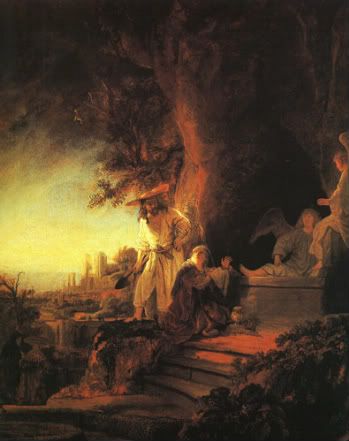
Rabboni!
Friday, April 10, 2009
Christ: Sacrifice and Victor
Yet we must not understand that he fell under a curse that overwhelmed him; rather - in taking the curse upon himself - he crushed, broke, and scattered its whole force. Hence faith apprehends an acquittal in the condemnation of Christ, a blessing in his curse. Paul with good reason, therefore, magnificently proclaims the triumph that Christ obtained for himself on the cross, as if the cross, which was full of shame, had been changed into a triumphal chariot! For he says that "Christ nailed to the cross the written bond which stood against us . . . and disarmed the principalities . . . and made a public example of them" [Col. 2:14-15]. And no wonder! For "Christ . . . through the eternal Spirit offered himself," as another apostle testifies [Heb. 9:14]. From this came that transmutation of nature. But that these things may take root firmly and deeply in our hearts, let us keep sacrifice and cleansing constantly in mind. For we could not believe with assurance that Christ is our redemption, ransom, and propitiation unless he had been a sacrificial victim. Blood is accordingly mentioned wherever Scripture discusses the mode of redemption. Yet Christ's shed blood served, not only as a satisfaction, but also as a laver [cf. Eph. 5:26; Titus 3:5; Rev. 1:5] to wash away our corruption.-John Calvin, Institutes 2.16.6
Tuesday, September 30, 2008
The Wonderful Exchange
This is the wonderful exchange which, out of his measureless benevolence, he has made with us; that, becoming Son of man with us, he has made us sons of God with him; that, by his descent to earth, he has prepared an ascent to heaven for us; that, by taking on our mortality, he has conferred his immortality upon us; that, accepting our weakness, he has strengthened us by his power; that, receiving our poverty unto himself, he has transferred his wealth to us; that, taking the weight of our iniquity upon himself (which oppressed us), he has clothed us with his righteousness.
- John Calvin, Institutes 4.17.2
Wednesday, October 3, 2007
Calvin on Holiness
Now what is to be learned from the law can be readily understood: that God, as he is our Creator, has toward us by right the place of Father and Lord; for this reason we owe him glory, reverence, love, and fear; verily, that we have no right to follow the mind’s caprice wherever it impels us, but, dependent upon his will, ought to stand firm in that alone which is pleasing to him; then, that righteousness and uprightness are pleasing to him, but he abominates wickedness; and that, for this reason, unless we turn away from our Creator in impious ingratitude, we must cherish righteousness all our life. For if only when we prefer his will to our own do we render to him the reverence that is his due, it follows that the only lawful worship of him is the observance of righteousness, holiness, and purity.
John Calvin, Institutes 2.8.2
Thursday, April 26, 2007
End of Semester Insanity
Well, now I've spent another hour procrastinating. God's Peace.