Showing posts with label CS Lewis. Show all posts

Sunday, March 11, 2012

Chronological Snobbery: A rant


Man can only find life among the dead.
-Chesterton

When I walk into a Christian bookstore I often feel a mixture of disgust and anger. Whether it's the visual insult of garish "Christian" "art" which usually involves an out-of-context Bible verse or some cheesy statement with no relationship whatsoever to Scripture slapped onto a tacky painting or the mind-numbing vacuity of most of the "literature" present, Christian bookstores are a place I generally try to avoid.  The thing that bothers me the most, though, is that in the great majority of Christian bookstores 99% of the books present were written by authors who are still living. Sure, they'll throw in some C.S. Lewis among the prosperity theologians and the writers of contentless sweet-nothings to tickle the ears but actual theological profundity is something very hard to come by.

The problem, in my opinion, is what has been called "chronological snobbery." C.S. Lewis likely coined the term and it is mentioned in his excellent autobiography, Surprised by Joy. The basic idea of "chronological snobbery" is that ideas and books and art that is made in our own time is somehow better or maybe more applicable than ideas and books and art from ages past. I think that this assumption, that the new is somehow better, is one of the worst and most damaging beliefs commonly held in Evangelical Christianity today - and it is held by nearly everyone.

Some of the best writing on this idea of chronological snobbery comes from G.K. Chesterton, before Lewis had ever coined the term. In his book, What's Wrong with the World, Chesterton wrote of "the modern mind," being "forced towards the future by a certain sense of fatigue, not unmixed with terror, with which it regards the past." He writes profoundly that "the future is a refuge from the fierce competition of our forefathers," and "I can make the future as narrow as myself; the past is obliged to be as broad and turbulent as humanity." Another idea I've seen expressed somewhere and with which I fully agree is that when we listen to the voices of ages past we live in a much more democratic world. This idea would also apply to the Church. Why do we accept the undemocratic idea that only those Christians currently living should have a vote when it comes to the interpretation of Scripture or the order of worship or the Christian life? Perhaps it is because the Church is not a democracy. But this fact does not save the modernist or post-modernist from scrutiny. Christ promised that the Holy Spirit would guide us into all truth (John 16:13) and I've often heard this verse used as a rationalization for some novel theology or practice among Christians. But if this promise is true, that the Holy Spirit has been guiding His people into all truth, then He has been doing it for the past 2000 years and not for the past 50 or 100 as most Evangelicals seem to understand it. Therefore when Christians have understood Scripture to say something about a theological issue for many centuries, their understanding should have more weight than whatever fads are currently affecting the Church.

If Christ has not returned in 500 years I am certain that nearly all modern writers will have passed out of the memory of the populace and of the Church. Perhaps C.S. Lewis will still be remembered and read. But I am certain that Athanasius and Augustine and Luther and Calvin will still be read and will still have a profound influence on God's people. So my question is, why do we waste our time on writers who will not stand the test of time when great riches of thought and theology and devotion by saints unquestionably inspired (not as Scripture is inspired) by God are readily available? I think the clear answer is arrogance. We audaciously think we have discovered a better Christianity or a clearer understanding of Scripture than they had. We should spurn that "refuge" of the future and instead keep company with that great communion of saints which has gone before us. We should commune with them in their understandings of Scripture, in the liturgy and in the sacraments which we share.

Sunday, October 16, 2011

C.S. Lewis on Tyndale and Protestantism


In reality Tyndale is trying to express an obstinate fact which meets us long before we venture into the realm of theology; the fact that morality or duty (what he calls ‘the Law’) never yet made a man happy in himself or dear to others. It is shocking, but it is undeniable. We do not wish either to be, or to live among, people who are clean or honest or kind as a matter of duty: we want to be, and associate with, people who like being clean and honest and kind. The mere suspicion that what seemed an act of spontaneous friendliness or generosity was really done as a duty subtly poisons it. In philosophical language, the ethical category is self-destructive; morality is healthy only when it is trying to abolish itself. In theological language, no man can be saved by works. The whole purpose of the ‘Gospel,’ for Tyndale, is to deliver us from morality. Thus, paradoxically, the ‘Puritan’ of modern imagination—the cold, gloomy heart, doing as duty what happier and richer souls do without thinking of it—is precisely the enemy which historical Protestantism arose and smote.


- C.S. Lewis, English Literature in the Sixteenth Century

Monday, October 4, 2010

When we stand before Him - Part 2


Over the weekend I found myself with some unexpected free time without any of the books I had brought along to read. I stopped at a bookstore and picked up one of the few C.S. Lewis books I hadn't previously read, a collection of essays called The Weight of Glory. As I read the first essay I was surprised to see that Lewis was dealing with many of the same issues I wrote about in my last blog post. I think some of what Lewis wrote might serve as a bit of a corrective to the attitude I wrote with in that last post. I don't disagree with anything I wrote, at least not at the moment, but I think Lewis makes a good point about the glory that the Christian can hope for in heaven. Lewis writes:
. . . And that is enough to raise our thoughts to what may happen when the redeemed soul, beyond all hope and nearly beyond belief, learns at last that she has pleased Him whom she was created to please. There will be no room for vanity then. She will be free from the miserable illusion that it is her doing. With no taint of what we should now call self-approval she will most innocently rejoice in the thing that God has made her to be, and the moment which heals her old inferiority complex forever will also drown her pride deeper than Prospero's book. Perfect humility dispenses with modesty. If God is satisfied with the work, the work may be satisfied with itself; "it is not for her to bandy compliments with her Sovereign.". . .
. . . It is written that we shall "stand before" Him, shall appear, shall be inspected. The promise of glory is the promise, almost incredible and only possible by the work of Christ, that some of us, that any of us who really chooses, shall actually survive that examination, shall find approval, shall please God.
Lewis' Arminianism perhaps comes out in his line about anyone who "really chooses," and that is a whole other debate I don't mean to touch on here. But when it comes to a redeemed person pleasing God, "only possible by the work of Christ," I think Lewis' thoughts in light of the rest of his essay are well argued from Scripture. It's been a blessing to read Lewis', as usual, amazing thoughts in this essay and it's helped me to think more about how I should understand good works.

Monday, April 12, 2010

New Books! #2


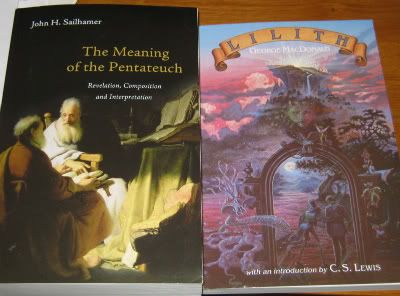
I finally put the gift card I got from my parents for Christmas to work and bought a few books. Unfortunately the next four months will probably be too busy to make much of a dent in either. The two I bought are very different from one another. Lilith by George MacDonald has been on my list of books to read for five or six years now since reading Phantastes by the same author. It was of Phantastes which C.S. Lewis wrote, "that the whole book had about it a sort of cool, morning innocence, and also, quite unmistakably, a certain quality of Death, good Death. What it actually did to me was to convert, even to baptise (that was where the Death came in) my imagination." I also found Phantastes to be captivating and was told that if I liked that book I would probably also like Lilith.

For Lent my church read through the Pentateuch. I stayed pretty much on schedule up until Leviticus and then kind of fell off. But I was reminded once again about how little I understand the Old Testament. I was also reminded of a book which John Piper had recently said was one of the best he'd ever read, John Sailhamer's The Meaning of the Pentateuch. It will probably take me a decade to read this book but if I ever do I think it will be well worth it.

Sunday, July 8, 2007

Discernment, Dwarfs and Digory

Okay, I know the title's a bit dorky but I couldn't help it. A series on discernment has materialized on this blog and now I have something to write that I really believe is from God. Of course, use your discernment as you read, but as I prepared to write it I got the funny feeling that God was saying, "Hey Matt, open your eyes, you've had it wrong." So here goes:

When is "discernment" really just cynicism? When is "discernment" just bowing down to the lies of enlightenment, materialistic thought? When does "discernment" get in the way of the supernatural and the unexpected? Can what we might think of as "discernment" really be a lie from Satan that keeps us away from God's blessing? I think it can. I think fear of the new and the miraculous and a cynical state of mind, unwilling to accept amazing and unexpected blessings from God, is often labeled as a discerning mind. I am guilty of all of these things. Lord help me to repent.

In "The Last Battle," the final book in his "The Chronicles of Narnia," C.S. Lewis includes a peculiar story of a group of Dwarfs who have come into Heaven from Narnia. They enter through a stable door. Chapter thirteen of The Last Battle begins with King Tirian, Peter, Lucy and Edmund Pevensie, Eustace, and Lord Digory and Lady Polly beginning to explore the paradise that is Heaven. Tirian and Eustace, like the dwarfs, entered Heaven through the stable door from Narnia. The Pevensies, Digory and Polly were all killed in a train accident on earth and are now in Heaven. Heaven is described by Lewis, thus: "They stood on grass, the deep blue sky was overhead, and the air which blew gently on their faces was that of a day in early summer. Not far away from them rose a grove of trees, thickly leaved, but under every leaf there peeped out gold or faint yellow or purple or glowing red of fruits such as no one has seen in our world. . . Everyone raised up his hand to pick the fruit he best liked the look of, and then everyone paused for a second. This fruit was so beautiful that each felt 'It can't be meant for me . . . surely we're not allowed to pluck it.' 'It's all right,' said Peter. 'I know what we're all thinking. But I'm sure, quite sure, we needn't. I've a feeling we've got to the country where everything is allowed.' 'Here goes then!' said Eustace. And they all began to eat. What was the fruit like? Unfortunately no one can describe it. All I can say is that, compared with those fruits, the freshest grapefruit you've ever eaten was dull, and the juiciest orange was dry, and the most melting pear was hard and woody, and the sweetest wild strawberry was sour."

Lewis' description here is somewhat reminiscent of his description in "The Great Divorce," with the fruit in Heaven being more real than any fruit on earth.

But the Dwarfs also entered Heaven through the stable door. Lucy leads the group to the Dwarfs and this is what they see: "They weren't strolling about or enjoying themselves . . . nor were they lying down and having a rest. They were sitting very close together in a little circle facing one another. They never looked round or took any notice of the humans till Lucy and Tirian were almost near enough to touch them. Then the Dwarfs all cocked their heads as if they couldn't see anyone but were listening hard and trying to guess by the sound what was happening.
'Look out!' said one of them in a surly voice. 'Mind where you're going. Don't walk into our faces!'
'All right!' said Eustace indignantly. 'We're not blind. We've got eyes in our heads.'
'They must be darn good ones if you can see in here,' said the same Dwarf whose name was Diggle.
'In where?' asked Edmund.
'Why you bone head, in here of course,' said Diggle. 'In this pitch-black, poky, smelly little hole of a stable.'
'Are you blind?' said Tirian.
'Ain't we all blind in the dark!' said Diggle.
'But it isn't dark, you poor stupid Dwarfs,' said Lucy. 'Can't you see? Look up! Look around! Can't you see the sky and the trees and the flowers? Can't you see me?'
'How in the name of all Humbug can I see what ain't there? And how can I see you any more than you can see me in this pitch darkness?'
'But I can see you,' said Lucy. 'I'll prove I can see you. You've got a pipe in your mouth.'
'Anyone that knows the smell of baccy could tell that,' said Diggle.
'Oh the poor things! This is dreadful,' said Lucy. Then she had an idea. She stooped and picked some wild violets. 'Listen, Dwarf,' she said. 'Even if your eyes are wrong, perhaps your nose is all right: can you smell that?' She leaned across and held the fresh, damp flowers to Diggle's ugly nose. But she had to jump back quickly in order to avoid a blow from his hard little fist.
'None of that!' he shouted. 'How dare you! What do you mean by shoving a lot of filthy stable-litter in my face? There was a thistle in it too.'

So the Dwarfs, who in reality are in Heaven, have so deluded themselves and are so cynical that they can't see the blue sky, the grass, the trees or even the light of heaven. They also have their rationalizations ready. When Lucy tries to prove to them that they are in the light by telling Diggle that he's smoking a pipe he just explains it away by saying that she could smell the tobacco. Because of the Dwarfs' unbelief, they can't see Heaven even though they are in it.

For you poor souls unfamiliar with Narnia, Aslan is a Great Lion and the character who represents Jesus Christ, God incarnate. Soon after the events described above, Aslan comes along. Here's the scene: ". . . but as he spoke the earth trembled. The sweet air grew suddenly sweeter. A brightness flashed behind them. All turned. Tirian turned last because he was afraid. There stood his heart's desire, huge and real, the golden Lion, Aslan himself, and already the others were kneeling in a circle round his forepaws and burying their hands and faces in his mane as he stooped his great head to touch them with his tongue. Then he fixed his eyes upon Tirian, and Tirian came near, trembling, and flung himself at the Lion's feet, and the Lion kissed him and said, 'Well done, last of the Kings of Narnia who stood firm at the darkest hour.'"

Isn't that a beautiful picture of intimacy with God?

Lucy asks Aslan to help the Dwarfs. Aslan answers, "I will show you both what I can, and what I cannot, do."

"He came close to the Dwarfs and gave a low growl: low, but it set all the air shaking. But the Dwarfs said to one another, 'Hear that? That's the gang at the other end of the stable. Trying to frighten us. They do it with a machine of some kind. Don't take any notice. They won't take us in again!'
Aslan raised his head and shook his mane. Instantly a glorious feast appeared on the Dwarfs knees: pies and tongues and pigeons and trifles and ices, and each Dwarf had a goblet of good wine in his right hand. But it wasn't much use. They began eating and drinking eagerly enough, but it was clear that they couldn't taste it properly. They thought they were eating and drinking only the sort of things you might find in a stable. One said he was trying to eat hay and another said he had got a bit of an old turnip and a third said he'd found a raw cabbage leaf. And they raised golden goblets of rich red wine to their lips and said 'Ugh! Fancy drinking dirty water out of a trough that a donkey's been at! Never thought we'd come to this.' . . . 'Well at any rate there's no Humbug here. We haven't let anyone take us in. The Dwarfs are for the Dwarfs.'
'You see,' said Aslan. 'They will not let us help them. They have chosen cunning instead of belief. Their prison is only in their own minds, yet they are in that prison; and so afraid of being taken in that they cannot be taken out. But come, children. I have other work to do.'"

Does it not break your heart? It didn't break my heart before but it does now for some reason. I think it's because I'm beginning to think most Christians, including myself, are like those Dwarfs. We're so cunning and so afraid of being 'taken in.' And why do we feel this way? Because of pride and fear. We don't want to look foolish. It seems foolish to believe that people get drunk in the Spirit and see angels and visit heaven. It seems foolish that God would cause something to materialize in thin air and fall on the worshippers at a church in California. But, "Has not God made foolish the wisdom of the world?" "For since in the wisdom of God the world through its wisdom did not know him, God was pleased through the foolishness of what was preached to save those who believe." Are we not, "Fools for Christ?"
But, "The foolishness of God is wiser than man's wisdom." If we say we believe the Bible and in the Bible people saw and conversed with angels, became like dead men in God's presence, received revelations and were caught up to the third heaven then why do we doubt now? Why do I doubt now? Lord, free me from my unbelief! When we trust people we risk being hurt. We risk believing lies. We risk admiring a fake. But does that mean that we should not trust? That we should not believe? That is the choice many of us make. But what are we missing? What feasts that God is laying before us do we see as 'stable litter?' What new wine do we see as trough-water? And what is the feast? What is the wine? The Psalmist says, "You are my portion, O Lord." Jesus said, "For my Flesh is real food and my Blood is real drink. Whoever eats my flesh and drinks my blood remains in me, and I in him." God is our portion.

Jesus said to Thomas, to Thomas who wouldn't believe the words of his own brothers and sisters that his Lord had been raised. He said to Thomas who had heard Jesus' own words predicting his resurrection, "blessed are those who have not seen and yet have believed." It all seemed too good to be true to Thomas. He knew that those other disciples wanted so badly for the resurrection to be true - maybe they had just imagined something and convinced one another of its truth. Thomas knew that people don't normally rise from the dead. But he also knew his Lord. He also knew the words of his Lord. He had been in close company with the other disciples for years. Yet he didn't trust any of that. It was too good to be true. He wasn't going to be 'taken in.' Thankfully Thomas' case wasn't as bad as the Dwarfs in the story. He did believe after he saw and touched his Lord and there proclaimed, "My Lord and my God!"

Let us not be so cunning in our "discernment" that we choose it over belief.

Amen

Wednesday, May 2, 2007

A Great Meditation on Materialism: Clouds of Atoms Making Mistakes

(Here Lewis considers naturalistic materialism as he struggles with grief at the loss of his wife whom he refers to as H.)
Come, what do we gain by evasions? We are under the harrow and can't escape. Reality, looked at steadily, is unbearable. And how or why did such a reality blossom (or fester) here and there into the terrible phenomenon called consciousness? Why did it produce things like us who can see it and, seeing it, recoil in loathing? Who (stranger still) want to see it and take pains to find it out, even when no need compels them and even though the sight of it makes an incurable ulcer in their hearts? People like H. herself, who would have truth at any price.

If H. 'is not,' then she never was. I mistook a cloud of atoms for a person. There aren't, and never were, any people. Death only reveals the vacuity that was always there. What we call the living are simply those who have not yet been unmasked. All equally bankrupt, some not yet declared.

But this must be nonsense; vacuity revealed to whom? Bankruptcy declared to whom? To other boxes of fireworks or clouds of atoms. I will never believe - more strictly I can't believe - that one set of physical events could be, or make, a mistake about other sets.

-C.S. Lewis, A Grief Observed

Thursday, April 26, 2007

End of Semester Insanity

The end of my last semester at Asbury Seminary in Wilmore, Kentucky draws near and my attention is focused on three large term papers I must finish by May 13th. I've taken some of the best classes I've ever had in any university setting this semester and all three papers should prove interesting. My classes this semester were "The Philosophy of C.S. Lewis" and "The Problem of Evil" with Dr. Walls and "The Theology of John Calvin" with Dr. O'Malley. Doctors Walls and O'Malley are two of my favorite professors here and the content of the courses has been quite good. I thought the subjects of my term papers might interest some of you so I describe them here below along with the appropriate illustrations:It's been cool taking a Calvin course at an Arminian seminary. I haven't yet taken our systematic theology (Basic Christian Doctrine) so the only systematic I will have taken on campus will have been John Calvin's. For class we've read the majority of The Institutes and a good biography by Wendell. My paper will focus on Calvin's idea of the third use of the law, how that theology affected his pastoral ministry and then compare that to Luther's concept of the law and how that affected his ministry. I'm not a fan of all of Calvin's theology but I do like his third use of the law. Basically, Calvin said that the law was useful to instruct Christians to lead a holy life. This is contrary to Luther's view where after a person is saved the law no longer has any claim on a person's life. “If I look to myself,” said Luther, “then all is flesh, all is sin. If I look to Christ, I am completely holy and pure, and I know nothing at all about the Law.”
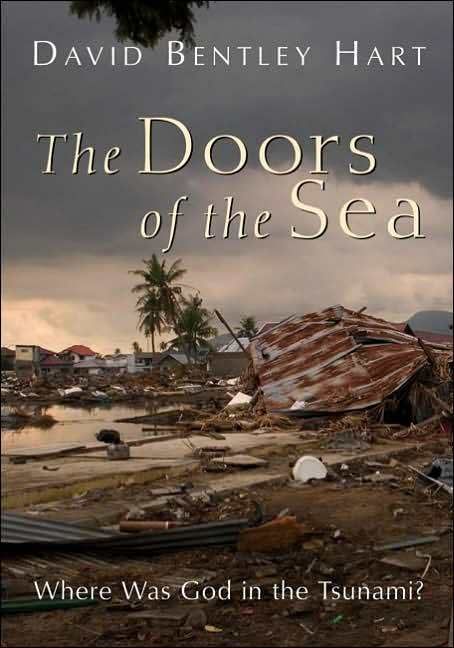
I chose the cover of David Bentley Hart's book The Doors of the Sea as the illustration for my Problem of Evil class because I thought it was such a poetic and profound account of the problem of evil and theodicy. I highly recommend this book! This class has been the best I've taken at Asbury. The readings have been intensely interesting and the class discussions enlightening. I became interested in one theme from The Doors of the Sea - that of the problem of natural evil. Hart suggests that natural evil could be the result of demonic activity. I'm going to go at this problem, trying to defend the thesis that natural evil is actually the result of a corruption of creation resulting from the fall. I'm going to check out some commentaries on Romans 8:20-21, "For the creation was subjected to futility, not willingly, but because of Him who subjected it in hope; because the creation itself also will be delivered from the bondage of corruption into the glorious liberty of the children of God," and go from there. I've started on my Lewis term paper and hope to finish it tomorrow. I'm exploring some ideas surrounding one of the characters from Lewis' The Great Divorce. The character is the liberal Episcopal bishop. The bishop has taken a bus ride from hell into heaven and has a discussion with a former friend and classmate who is in heaven. The chapter is a wonderful indictment of liberal theology and I would say also much of postmodern thought. Let's just say I bring a lot of passion to this subject - I grew up in a liberal church and I'm still recovering. I think a lot of Christians, epecially those who have always been around evangelicals or fundies, are very ignorant of the serious dangers of liberal theology. I love what one of my professor's Lawson Stone had to say about liberalism, "I personally believe it to be the most effective heresy Satan ever fomented on the church."

Well, now I've spent another hour procrastinating. God's Peace.