
"If my mental processes are determined wholly by the motion of atoms in my brain, I have no reason to suppose that my beliefs are true... and hence I have no reason for supposing my brain to be composed of atoms"
-JBS Haldane
Quoted during a lecture on neuroscience and free-will at Loma Linda University
Thursday, March 13, 2008

Sunday, March 9, 2008
Chrysostom's advice for Insomniacs

Wonderful advice from the "Gold-mouthed" Father...
Almost all of us at times find ourselves unable to sleep at night. We lie awake during the dark, silent hours. This rarely happens when our hearts and souls are at peace; it usually happens when we are troubled in some way. For this reason do not curse for your lack of sleep. These times of wakefulness have been sent by God as a sign that something is wrong, and as a period for reflection. So when you cannot sleep, allow the thoughts that lie deepest in your heart to rise up to the surface. Often these thoughts are a reproach, telling you of a sin you have committed or an act of charity you failed to perform. If you have already confessed and made amends for these past failures, then you must assure yourself that God has forgiven you, so that you can sleep in peace. But if you have not confessed and made amends, then you must confess at once, admitting to God the precise nature of your sin, and asking forgiveness. Then you must plan how the following day you can put right your wrong. You might be so troubled that even then you cannot sleep. But do not worry: your mind and body will eventually sleep when your soul is at rest.
- St. John Chrysostom
Thursday, February 28, 2008
Couldn't have said it better myself...
“From a child I was taught to love and reverence the Scripture, the oracles of God; and, next to these, to esteem the primitive Fathers, the writers of the first three centuries. Next after the primitive Church, I esteem our own, the Church of England."
-John Wesley
From the Works of John Wesley, ed. Thomas Jackson, Vol. XIII, p. 234
-John Wesley
From the Works of John Wesley, ed. Thomas Jackson, Vol. XIII, p. 234
Sunday, February 24, 2008
Humility
"There is generally upon my heart such a sense of my unworthiness that sometimes I dare hardly open my mouth before a child of God; and think it an unspeakable honor to stand before one who has recovered something of the image of God, or sincerely seeks after it. Is it possible that such a sinful worm as I should have the privilege to converse with one whose soul is besprinkled with the blood of my Lord? The thought amazes, confounds me; and fills my eyes with tears of humble joy."
- John Fletcher - Anglican Priest, Associate of John Wesley and early Methodist leader
- John Fletcher - Anglican Priest, Associate of John Wesley and early Methodist leader
Wednesday, February 13, 2008
God's Power in the Darkness
I just finished reading an excellent book last night. It is one that had been recommended to me many times and perhaps because of the many recommendations I had held off on reading it until now. But this book overwhelmed me again and again by its testimonies of God's love and power, much like The Cross and the Switchblade has done as I've read and re-read that book. The book is The Hiding Place by Corrie Ten Boom. If you've read my blog for very long, you know that one of the philosophical issues I'm most interested in is the problem of theodicy, that is, justifying a good and all-powerful God in a world where so many horrible evils occur.  I feel like this book adds something to the whole theodicy conversation. It is clear that God was at work even in the midst of the worst evil of the last century. God did not step in and limit the freedom of the Nazis as they committed their heinous crimes but God did use those who would be obedient even to the point of death to save some of His chosen people, the Jews, and to bring comfort and salvation to some of those in concentration camps who were about to go to the gas chambers. I was struck by the centrality of Scripture for the ten Boom family, how the Bible was the authority when it came to life and belief. I was also struck by a statement by Caspar, Corrie's father when, as a little girl, she asked him what "sexual sin" was. Caspar said something like, that is a knowledge that is too dark for you to be burdened with. Later that same line of thought is applied by Corrie to the problem of evil itself. I think that is one of the hardest things for us in this scientific age to accept that in this life we may not get pat and satisfying answers to our deepest, darkest questions. Even in the midst of this ambiguity we must find the ability to live a life of trust in God. If we can't learn to live with the things that don't make sense, I think we can only go down the road of despair or of dishonesty where we try to convince ourselves that the easy answers really satisfy us. When it comes to things like horrible diseases or the holocaust, no answer really satisfies me. But we must continue on, seeking to bring God's light, love and healing into the dark places and believing that these "present sufferings are not worth comparing with the glory that will be revealed in us."
 I feel like this book adds something to the whole theodicy conversation. It is clear that God was at work even in the midst of the worst evil of the last century. God did not step in and limit the freedom of the Nazis as they committed their heinous crimes but God did use those who would be obedient even to the point of death to save some of His chosen people, the Jews, and to bring comfort and salvation to some of those in concentration camps who were about to go to the gas chambers. I was struck by the centrality of Scripture for the ten Boom family, how the Bible was the authority when it came to life and belief. I was also struck by a statement by Caspar, Corrie's father when, as a little girl, she asked him what "sexual sin" was. Caspar said something like, that is a knowledge that is too dark for you to be burdened with. Later that same line of thought is applied by Corrie to the problem of evil itself. I think that is one of the hardest things for us in this scientific age to accept that in this life we may not get pat and satisfying answers to our deepest, darkest questions. Even in the midst of this ambiguity we must find the ability to live a life of trust in God. If we can't learn to live with the things that don't make sense, I think we can only go down the road of despair or of dishonesty where we try to convince ourselves that the easy answers really satisfy us. When it comes to things like horrible diseases or the holocaust, no answer really satisfies me. But we must continue on, seeking to bring God's light, love and healing into the dark places and believing that these "present sufferings are not worth comparing with the glory that will be revealed in us."
Sunday, February 10, 2008
San Gorgonio Mountains - Momyer Creek
On Saturday, after a week of midterm exams, I felt the need to get away so I headed east to the snow-capped San Gorgonio Mountains and found a hiking trail, Momyer Creek, east of Forrest Falls, California. It was a beautiful day and the hike was very enjoyable. I had my best hiking companion with me, my Bible, and I was able to read and pray some Psalms in the solitude of the mountain. Here are some pictures I took with my new digital camera:
 This shot shows some of the common flora, an Opuntia cactus and in the background the dry flowering head of an Agave.
 I don't know what I'd do with out the time-delay option. It is always interesting trying to find something to balance my camera on in the wilderness though.
 Looking back down at the valley of Mill Creek. The hike starts at the valley floor.
 The high mountains belong to the wild goats;
the crags are a refuge for the coneys. - Psalm 104:18
 This shot shows some of the common flora, an Opuntia cactus and in the background the dry flowering head of an Agave.
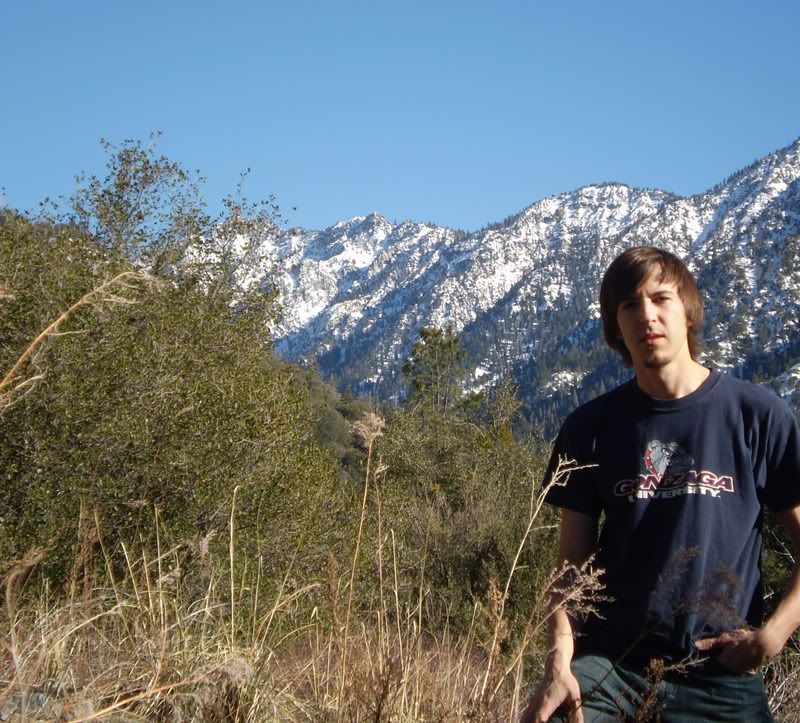 I don't know what I'd do with out the time-delay option. It is always interesting trying to find something to balance my camera on in the wilderness though.
 Looking back down at the valley of Mill Creek. The hike starts at the valley floor.
 The high mountains belong to the wild goats;
 the crags are a refuge for the coneys. - Psalm 104:18
Monday, February 4, 2008
The Joy of Thanksgiving
Okay, I know, I know, - it's February and Thanksgiving is in November but something hit me today as I walked out of my anatomy and histology midterms. The exams went well and as I walked to my car I quietly sang a hymn of thanks and praise to God. And I realized that it is a great blessing to have Someone to thank. If I were an Atheist I guess I could find some happiness in feeling lucky or something but it seems like something would be truly missing not to be able to praise God for the blessings of this life. I had read someone else saying the same thing before, that they felt sorry for Atheists because they couldn't be thankful to God. For some reason when I first read that it didn't make much of an impact on me but today it just hit me for some reason.
Of course, the hard part is being thankful even when things don't go well. Not being a Calvinist, I think that things happen in reality that are truly contrary to the will of God. I don't think that God willed horrendous evils like the holocaust to take place. So I think 'giving thanks' for the holocaust would be wrong. But I think that as Christians we should always be able to give thanks. When the very reality of our existence is that we are sinners saved and redeemed by the Blood of the Lamb, I don't see how we can be anything but thankful in all situations.
Of course, the hard part is being thankful even when things don't go well. Not being a Calvinist, I think that things happen in reality that are truly contrary to the will of God. I don't think that God willed horrendous evils like the holocaust to take place. So I think 'giving thanks' for the holocaust would be wrong. But I think that as Christians we should always be able to give thanks. When the very reality of our existence is that we are sinners saved and redeemed by the Blood of the Lamb, I don't see how we can be anything but thankful in all situations.
Saturday, February 2, 2008
As though they were our own words...
In some of my rare moments of free time I have been reading St. Athanasius’ Letter to Marcellinus. The letter concerns mainly the Psalms, one of my favorite parts of Scripture, and I think what I read the other day in this text is one of the best and truest statements about the Psalms I have ever seen:
There is also this astonishing thing in the Psalms. In other books, those who read what the holy ones say, and what they might say concerning certain people, are relating the things that were written about those earlier people. And likewise, those who listen consider themselves to be other than those about whom the passage speaks, so that they only come to the imitation of the deeds that are told to the extent that they marvel at them and desire to emulate them. By contrast, however, he who takes up this book – the Psalter – goes through the prophecies about the Savior, as is customary in the other Scriptures, with admiration and adoration, but the other psalms he recognizes as being his own words. And the one who hears is deeply moved, as though he himself were speaking, and is affected by the words of the songs, as if they were his own songs. And for the sake of clarity of expression, do not hesitate, as the Apostle says, to repeat the very things they say…
I remember how years ago when I began praying the Psalms how I was often amazed by the fact that the Psalm put into words what I needed to say to God so much better than anything I could come up with. What a wonderful thing it is that in the middle of God’s Word we have this prayer-book for His people through which we can praise our Maker and receive much blessing from him.
Friday, January 25, 2008
The 11th Commandment?
If you really keep the royal law found in Scripture, "Love your neighbor as yourself," you are doing right. But if you show favoritism, you sin and are convicted by the law as lawbreakers. For whoever keeps the whole law and yet stumbles at just one point is guilty of breaking all of it. For he who said, "Do not commit adultery," also said, "Do not murder." If you do not commit adultery but do commit murder, you have become a lawbreaker. - James 2:8-11
A group of us at Loma Linda began a men's small group last fall. We meet once a week for Bible study, prayer and accountability. Our group includes 12 men and we break up into four accountbility groups of three each. For our Bible study, one of the accountability groups will take the responsibility of leading for each week. This week my group led and the passage we looked at was James 2:1-13. As is always the case with Scripture, I was amazed by the amount of depth I began to see in what is written as my colleagues and I began to try to put together the Bible study.
In this passage, James is trying to combat a problem that had arisen among the Christians to whom he was writing. This problem, showing favoritism to the rich, is ubiquitous so this Scripture applies well to Christians of all times. One thing that especially struck me was the way James framed the sin of showing partiality in verses eight through eleven. In this section, James calls showing partiality a sin against the "royal law," "love your neighbor as yourself." He goes on to remind us of the truth that when we transgress the law in one way, we have transgressed the entire law, becoming a lawbreaker. What struck me was that showing partiality is seen in the same way as murder or adultery, commandments of the decalogue. This reminded me of Jesus' own reaction to the pharisees, who did an excellent job of keeping the commandments but failed in being obedient to God. When James elevates the showing of favoritism to the same level as murder or adultery he elevates a sin that seems so natural and can be so subtle to the same level of those sins which often look so ugly and are easy to condemn. When we look at ourselves and try to determine whether or not we are living lives of obedience to God, do we ask ourselves whether we are making distinctions and showing partiality among our brothers and sisters or among those who are outside of the Church? As for myself I know that this is not something I often think about when I examine my actions. But for James, this showing of partiality is something that must be eradicated from the life of the Christian.
One other thing we discussed was how general this command to be impartial is. In the passage in James it obviously applies to class distinctions. But I believe that this command is general, applying to race, age and individual inclinations to sin, among other things. I think one thing that would be wrong to do with this passage would be to think that we shouldn't be discerning when we call people to positions of church-leadership. I believe that all Scripture in reality has the same Author, that is the Holy Spirit, so I don't believe that there is any contradiction when we see that there are qualifications which must be met to be elevated to the position of a leadership within the Church.
In conclusion, I was convicted by this passage and reminded of the character of Christ. I also thought that it fit well with the celebration of the life and work of Dr. Martin Luther King, Jr. which we celebrated earlier this week.
A group of us at Loma Linda began a men's small group last fall. We meet once a week for Bible study, prayer and accountability. Our group includes 12 men and we break up into four accountbility groups of three each. For our Bible study, one of the accountability groups will take the responsibility of leading for each week. This week my group led and the passage we looked at was James 2:1-13. As is always the case with Scripture, I was amazed by the amount of depth I began to see in what is written as my colleagues and I began to try to put together the Bible study.
In this passage, James is trying to combat a problem that had arisen among the Christians to whom he was writing. This problem, showing favoritism to the rich, is ubiquitous so this Scripture applies well to Christians of all times. One thing that especially struck me was the way James framed the sin of showing partiality in verses eight through eleven. In this section, James calls showing partiality a sin against the "royal law," "love your neighbor as yourself." He goes on to remind us of the truth that when we transgress the law in one way, we have transgressed the entire law, becoming a lawbreaker. What struck me was that showing partiality is seen in the same way as murder or adultery, commandments of the decalogue. This reminded me of Jesus' own reaction to the pharisees, who did an excellent job of keeping the commandments but failed in being obedient to God. When James elevates the showing of favoritism to the same level as murder or adultery he elevates a sin that seems so natural and can be so subtle to the same level of those sins which often look so ugly and are easy to condemn. When we look at ourselves and try to determine whether or not we are living lives of obedience to God, do we ask ourselves whether we are making distinctions and showing partiality among our brothers and sisters or among those who are outside of the Church? As for myself I know that this is not something I often think about when I examine my actions. But for James, this showing of partiality is something that must be eradicated from the life of the Christian.
One other thing we discussed was how general this command to be impartial is. In the passage in James it obviously applies to class distinctions. But I believe that this command is general, applying to race, age and individual inclinations to sin, among other things. I think one thing that would be wrong to do with this passage would be to think that we shouldn't be discerning when we call people to positions of church-leadership. I believe that all Scripture in reality has the same Author, that is the Holy Spirit, so I don't believe that there is any contradiction when we see that there are qualifications which must be met to be elevated to the position of a leadership within the Church.
In conclusion, I was convicted by this passage and reminded of the character of Christ. I also thought that it fit well with the celebration of the life and work of Dr. Martin Luther King, Jr. which we celebrated earlier this week.
Tuesday, January 22, 2008
Palm Springs
On Martin Luther King Jr. day I decided to get out of town to study. I ended up in Palm Springs with four of my classmates. We spent the morning at a coffee shop and the rest of the day at an Italian restaurant. I got some good hours of studying in . . . I can now tell you about all of the many layers of your retina and cornea, among other things. As we were preparing to leave I noticed a beautiful shot of the moon, some clouds and two palm trees. Thankfully, I had my new digital camera my parents gave me for Christmas. I figured this picture was as good of a reason as any to start blogging again. I don't promise I'll be writing anything worth your time but expect a post now and again if you do choose to stop back by.


Subscribe to:
Posts (Atom)

